Mideast Alliances Shift as Iran’s Power Wanes

Will a Sunni Islamist front, complete with a Pakistani nuclear umbrella, become as menacing as Shiite Iran has been?

Scott Norvell/The New York Sun
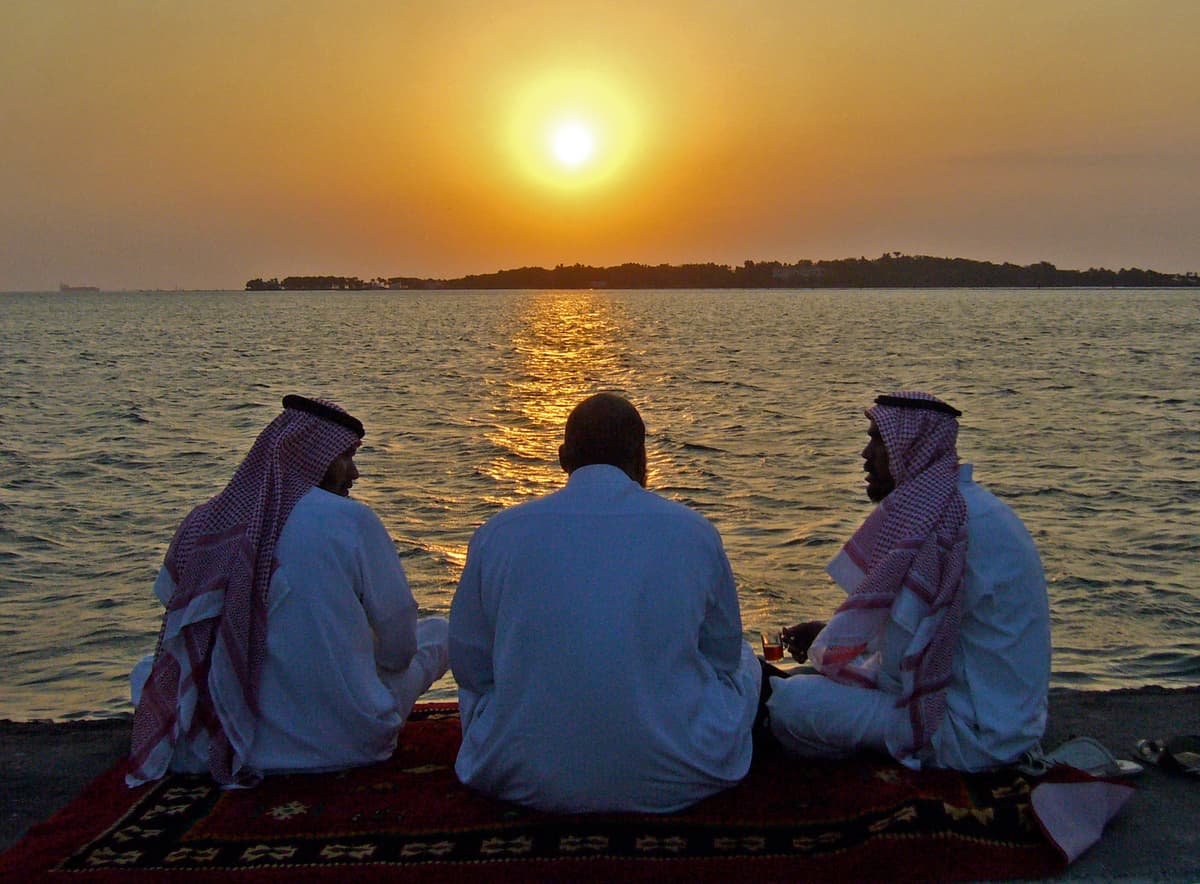
Saudi men watch the sunset on the waterfront in Jeddah. Scott Norvell/The New York Sun

The Middle East, already shaken after a two-year war launched by Hamas on October 7, 2023, is anticipating another seismic event — a possible collapse of the Iranian Islamic Republic. As alliances shift, hardened Sunni Islam is on the rise, competing with moderating forces. 

Turkey, which hosts Hamas leaders, is reportedly considering joining Saudi Arabia and Pakistan in a defense pact that could unite top Islamist regimes across South Asia, Europe, and the Arabian peninsula. Riyadh, meanwhile, is lashing out at its former close ally, the United Arab Emirates, even while it tightens relations with a former foe, Qatar. 

The Islamic Republic of Iran has flexed its muscles across the Mideast since 1979. Now, many in the region welcome signs of its possible collapse. America and Israel degraded Tehran’s military power, but will a Sunni Islamist front, complete with a Pakistani nuclear umbrella, replace them and become as menacing as Shiite Iran has been?

Some of the new alliances seem to make little sense. Until very recently, the Saudi ruler, Crown Prince Mohamed bin Salman, was widely seen as a force for modernizing his country and the region. He opened the Saudi Kingdom to Western influences and turned his back on Muslim extremists. Now, he appears to be moving in the opposite direction. 

Ideological and religious trends aside, personal and tribal alliances can never be underestimated. The Mideast realignments are “extraordinary, but they could change again,” a former United Nations official involved in Mideast negotiations, Jamal Benomar, tells the Sun. “As usually happens, big egos are involved,” he says, adding though, “there are some ideological differences, and they all involve the Muslim Brotherhood.”  

One of the reasons that the Riyadh-led Gulf Cooperation Council cut ties with Qatar in 2018 was Doha’s promotion of the Muslim Brotherhood. A decade ago Mr. Benomar shuttled around the Gulf as the UN envoy to Yemen. At that time, a Saudi-Emirati alliance was conducting a futile war against the Iran-backed Houthis. Now, the Saudis play host to the Brotherhood’s Yemeni chapter.

Then there is Riyadh’s alliance with Ankara. Under President Recep Tayyip Erdogan, Turkey shifted away from its secularist past and is now sponsoring Hamas and other militant Islamists. When the Saudi dissident Jamal Khashoggi, who had ties to the Muslim Brotherhood, was assassinated at Istanbul by Riyadhi agents, the two countries nearly came to blows.    

“The Saudis have a long memory and they will not likely forget that it was the Turks that made quite a stink about the Khashoggi affair — and that was only seven years ago, and it was the same leader, the same regime,” the executive director at the Foundation for Defense of Democracies, Jonathan Schanzer, tells the Sun.

Now, though, Mr. Schanzer says, “the idea of consolidated Sunni power in the region, I think, is very appealing to the Saudis, especially as we eye the potential collapse of the Islamic Republic.”

For half a century, he adds, events were “not the natural order of things in the Arab world and the Muslim world.” The Shiite Islamic Republic’s regional power “was really a nightmare for the Sunni states.” As Tehran and its proxies weaken, the Saudis see “an opportunity to put the Sunnis back at the top of the food chain,” he says, Yet “they understand they can’t do it alone,” which leads them to the emerging alliance with Pakistan, Turkey, and Qatar. 

Another factor is President Trump’s close relations with Islamist Qatar. The Saudis started suspecting that Washington’s Doha love affair trumps their own, “so they tightened their own relations with Qatar,” the president of the Middle East Media Research Institute, Ygal Carmon, tells the Sun. 

The Saudi-Qatari alliance turned against the one country that bucked the growing Islamization trend — the UAE — which is also emerging as Israel’s strongest ally in the region. Last week, the Saudis bombed the UAE’s allies at Hadramout, Yemen, hitting Emirati ships in the Red Sea. The attack forced Abu Dhabi to remove its forces from Yemen. 

“The Emiratis are going in the direction of humanism and westernization,” Mr. Carmon says. They hosted Pope Francis for an unprecedented visit in 2019, something that for religious reasons Riyadh would never do. “All disputes involve ideologies,” Mr. Carmon says. “The Saudis went through some cosmetic changes, but they haven’t taken the same bold steps that the Emiratis did.”

The Abrahamic Family House at Abu Dhabi hosts the Ahmed El-Tayeb Mosque, St. Francis Church, and Moses Ben Maimon Synagogue under one roof. “We serve to deepen understanding of our common humanity through mutual dialogue, exchange of knowledge, and the practice of faith,” according to its website.

Beyond its borders, the UAE is not necessarily allied with angels. Yet, unlike the Turks, the Qataris and others, the Emriatis tend to back anti-Muslim Brotherhood forces. 

“In Sudan, the Emiratis are backing the killer Delgado over the Islamist killer Burhan,” Mr. Carmon says. He refers, respectively, to the Sudanese leader of the Rapid Support Forces, General Mohamed Hamdan Dagalo, known as Hamedti, and to his rival, the Transitional Sovereignty Council’s Abdel Fattah al-Burhan. 

Similarly in Libya, the Emiratis support a Tubrok-based group led by Field Marshal Khalifa Haftar. Meanwhile Turkey, Qatar, and the UN, back Fayez al-Sarraj‘s Government of National Accord. None of these Libyan players are dedicated to human rights, but their backers are divided according to the emerging Mideast ideological rift. 

In the Horn of Africa the UAE is backing Somaliland, which was recently recognized by Israel. Turkey is entrenching itself in nearby Somalia. The risk of direct confrontation there might increase as regional alliances gel.


The New York Sun

© 2026 The New York Sun Company, LLC. All rights reserved.

Use of this site constitutes acceptance of our Terms of Use and Privacy Policy. The material on this site is protected by copyright law and may not be reproduced, distributed, transmitted, cached or otherwise used.

The New York Sun

Sign in or  create a free account

or
By continuing you agree to our Privacy Policy and Terms of Use