
Netanyahu Visit Will Be Heavy on Persuading Trump of the Trouble for America From an Unstable Middle East
The prime minister will detail the perils of positioning organized and hostile military forces as peacemakers in Gaza.
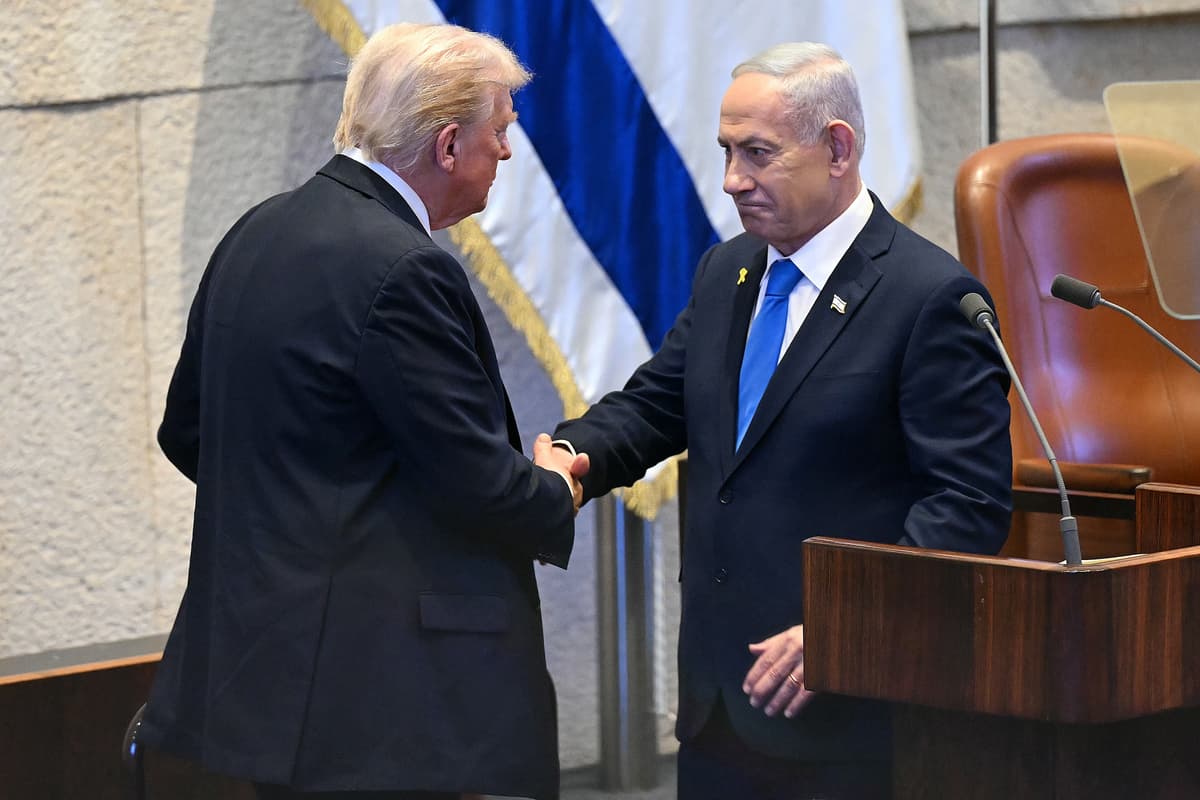
Prime Minister Netanyahuâs meeting with President Trump Monday comes at a critical juncture in the Gaza peace agreement, as reports suggest the presidentâs interest and commitment to greater Middle East security may be waning.
Mr. Trump has been characterized lately as seemingly less enamored by Mr. Netanyahu, whose insistence on maintaining a secure military flank around Gaza has irked his inner circle and threatens the presidentâs 20-point peace plan. An Axios report on Friday suggested that the presidentâs aides â from Vice President JD Vance and his chief of staff Susie Wiles to peace negotiators Jared Kushner and Steve Witkoff â are sick of dealing with concerns raised by Mr. Netanyahu, who is coming to America for his fifth meeting with the president.
Mr. Trump, who has been notably subdued about the visit and his relationship with Mr. Netanyahu, remains central to closing the chasm between the pledges and the reality of the peace deal. As head of the newly formed Gaza Board for Peace, which he is chairing alongside a group of U.N. technocrats and international mediators, Mr. Trump is the glue holding together the transition to a new Palestinian government, oversight of Gazaâs reconstruction, and implementation of the International Stabilization Force responsible for disarming Hamas.
The board is expected to have its first meeting early next month. Mr. Trump will reportedly name the former U.N. Special Coordinator for the Middle East Peace Process, Nickolay Mladenov, as the high representative in Gaza responsible for managing a slate of Palestinian technocrats overseeing day-to-day governance strategy.
During this second phase of the peace deal negotiated with Arab and Muslim nations and absent Mr. Netanyahu, Israel is expected to pull back from its yellow line positions in Gaza. The move is welcomed by Gazans and their supporters, but fraught with peril for Israel, which is hesitant to hand over security responsibilities to Hamas backers, Turkey and Qatar.
As some observers have noted, this stage is also a challenge to Mr. Trumpâs reputation as a mediator. âAllowing countries extremely hostile to Israel being involved is bad for the United States of America and will reduce the likelihood of any real peace,â the president of the Zionist Organization of America, Mort Klein, tells the Sun.
Mr. Netanyahu has âgot to make Trump understand â I say this as an American citizen â that this is bad for America. This is bad for Trumpâs interests in getting peace. You cannot get a real peace with Turkey and Qatar involved,â he says.
Political commentator Mark Levin also called the proposition of Turkish and Qatari forces in Gaza âabsurd and dangerousâ and lit up over the anonymous report that Israel is being bullied into accepting âa grave threat against its citizens now and in perpetuity.â
âPresident Trumpâs supporters are among the most ardent and numerous of Israelâs supporters. And they ought not be misled by the noise of the frauds and phonies, many of whom are outright bigots or bought-for Islamist propagandists or both,â he wrote on X.
âISRAEL CAN NEVER AND MUST NEVER AGREE TO THIS. And I cannot imagine President Trump would ever make such demands,â he added.
Aside from the peace deal, also front and center on Mr. Netanyahuâs agenda is likely to be the re-emerging threat from Iran, which is rebuilding its ballistic missile program even as Tehran is suffering through a harrowing economic forecast and a depleted nuclear arms program.
On Saturday in a wide-ranging interview published on the official website of Ayatollah Ali Khamene, Iranâs president, Masoud Pezeshkian declared Iran to be in a âfull-fledged warâ with the United States, Israel, and Europe. Speaking between the lines, Mr. Pezeshkianâs remarks indicated that the 12-Day War in June and long-running sanctions, along with severe drought, have damaged Iranâs economy and its capacity to provide food, energy, and gas to its people.
He accused the three powers of attempting to destabilize Iran politically, economically, and culturally as protests in Iran on Sunday â an angry response to the falling buying power of Iranâs currency against â reinforced the severity of his words.
âThey are besieging us from every aspect, they are putting us in difficulty and constraint, creating problems â in terms of livelihood, culturally, politically, and security-wise â while raising societyâs expectations. On one side, they block our sales, our exchanges, our trade, and on the other side, expectations in society have risen! Consequently, we must all help with all our might to fix the country,â Mr. Pezeshkian said.
Nonetheless, despite the problems confronting Iran, Mr. Pezeshkian said Iranâs military forces are âfar strongerâ than in previous conflicts and can deliver a âmore decisive response.â
If Mr. Netanyahu wishes to retain Mr. Trumpâs interest in deterring Iran, he will have to remind the president of the harm facing America to leave Iranâs regime intact, Mr. Klein said.
âThe Iran machine is still in power. And theyâre already rehabilitating their ballistic missile systems, which can carry a nuclear weapon. Theyâre a huge danger to Israel and a bigger danger to America,â Mr. Klein said. âThis is from an America first perspective, period. If Israel didnât exist, you have to take this strong action against Iran. If Israel didnât exist, America should take strong military action against Iran.â