South Korean Democrats Push for Access to Demilitarized Zone in Move To Undermine Korean-American Alliance, Woo North Korea’s Leader

The American general in charge of U.N. Command in the DMZ says civilian access will weaken South Korea’s security.
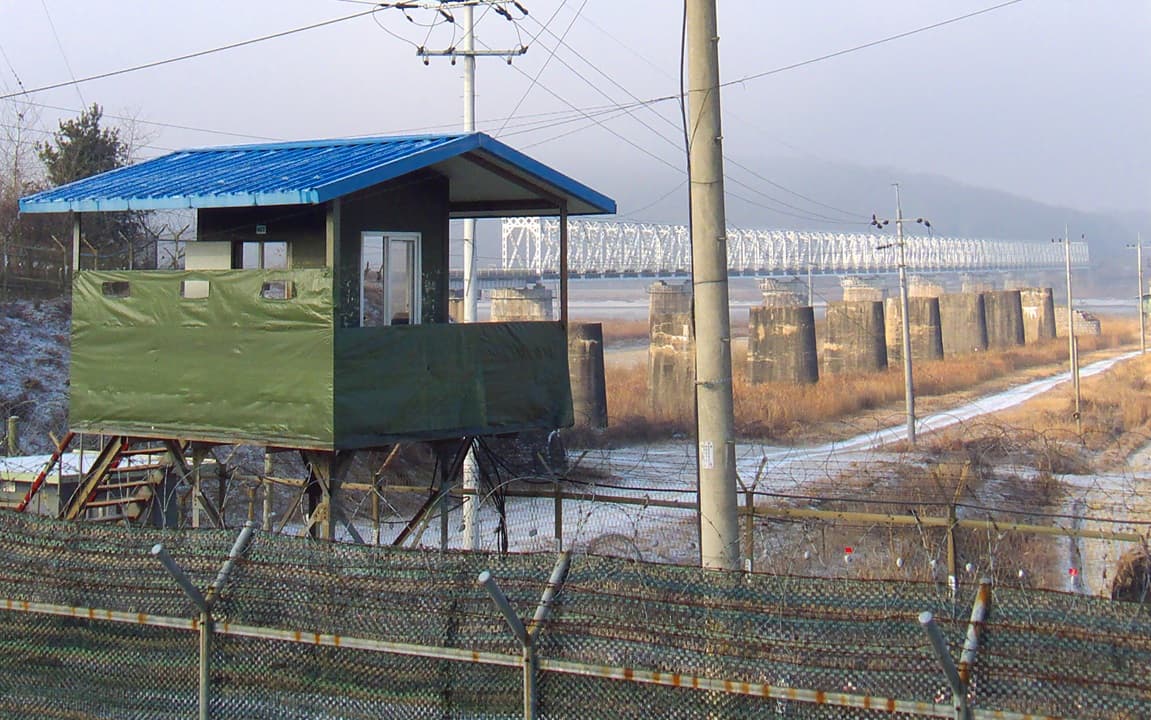

yeowatzup, CC BY 2.0 (https://creativecommons.org/licenses/by/2.0), via Wikimedia Commons
The Civilian Control Line at Imjingak Park outside Paju, South Korea. yeowatzup, CC BY 2.0 (https://creativecommons.org/licenses/by/2.0), via Wikimedia Commons

Americans are battling South Koreans over control of the exact place through which North Korean troops invaded the South more than 75 years ago.

They are brandishing pieces of paper, not weapons, in a dispute over access to the demilitarized zone that’s divided North from South Korea ever since the signing of the armistice that ended the war in July 1953 at the truce village of Panmunjom 44 miles north of Seoul.

The general in command of America’s 28,500 troops in South Korea and the United Nations Command, under which Americans, South Koreans and troops from 14 other countries fought the Korean War, flatly opposes a leftist-led proposal for the South to decide on civilian entry into the demilitarized zone.

“We don’t allow that area to become politicized,” General Xavier Brunson said in an interview with the website, War on the Rocks. “We signed an agreement,” he said, referring to the armistice. “We have to continue to engage there. What governs our behavior is the armistice.”

General Brunson’s remarks were a sharp rejoinder to a bill proposed by members of South Korea’s ruling Democratic Party in a bid to undermine the Korean-American alliance while seeking reconciliation with North Korea.

“The UNC and the United States generally make every effort to support the ROK government through formal, negotiated processes. What we are seeing here appears to be more of a political grandstanding gesture aimed at media attention,” a retired American army officer, Steve Tharp, who’s spent years watching the drama on the DMZ, tells the Sun. 

“Serious issues related to the DMZ and the Armistice are settled through negotiated agreements, not unilateral actions,” he says.

General Brunson let his views be known after the U.N. Command, presumably on his instructions, declared that “civil administration” below the line in the middle of the four-kilometer-wide zone that divides North from South Korea “shall be the responsibility of the commander-in-chief of the United Nations Command.”

The debate poses a threat to Korean-American relations as long as South Korea’s Democratic Party remains in power under the president, Lee Jae-myung. Mr. Lee has not commented, but party stalwarts in the national assembly see civilian access to the zone as a step on the way to dialogue with North Korea’s leader, Kim Jong-un.

“The general assertion of control over the DMZ by the UNC — which very rarely issues public statements — appeared to come in response to recent movements by lawmakers with the ruling Democratic Party,” reported the leftist newspaper Hankyoreh, adding that legislators had sponsored a bill “on the peaceful use of the DMZ.”

Veterans of years of military experience along the demilitarized zone strongly oppose the bill, seen as undermining defense of the South where it’s needed most.

The U.N. commander “would certainly be blamed by many of the same politicians — particularly through the media — if something were to go wrong,” says Mr. Tharp, who has led numerous tours of both civilians and military people to the zone, observed that “any meaningful change requires a signed agreement among the relevant parties, which could potentially even include the North Koreans.”

A retired South Korean lieutenant general, Chun In-bum, was still more emphatic. “The DMZ is not a park, a museum, or a confidence-building playground,” General Chun wrote in the English-language Korea Times. “ It is the last physical and legal barrier between armistice and war.”

The U.N. Command, General Chun noted, “is not merely a U.S.-led military venture.” Rather, he said, “It is a multinational command established pursuant to United Nations Security Council resolutions. Its authority under the armistice provides part of the international legal foundation for the U.S. and allied military presence in Korea.” Attempts to “sideline or erode the UNC’s role,” he said, “risk introducing ambiguity into deterrence and crisis management.”

In an editorial, however, the Korea Times took a different view. The U.N. Command and the Korean government “should consult closely on flexible management of access to the DMZ,” reads the paper, citing “criticism of the UNC’s strict management of South Korea’s access to the DMZ.”


The New York Sun

© 2025 The New York Sun Company, LLC. All rights reserved.

Use of this site constitutes acceptance of our Terms of Use and Privacy Policy. The material on this site is protected by copyright law and may not be reproduced, distributed, transmitted, cached or otherwise used.

The New York Sun

Sign in or  create a free account

or
By continuing you agree to our Privacy Policy and Terms of Use