

The Federal Reserve Was Designed To Make Money for the Government

Instead, estimates suggest, its gamble on bonds and mortgages has cost the Treasury more than $500 billion
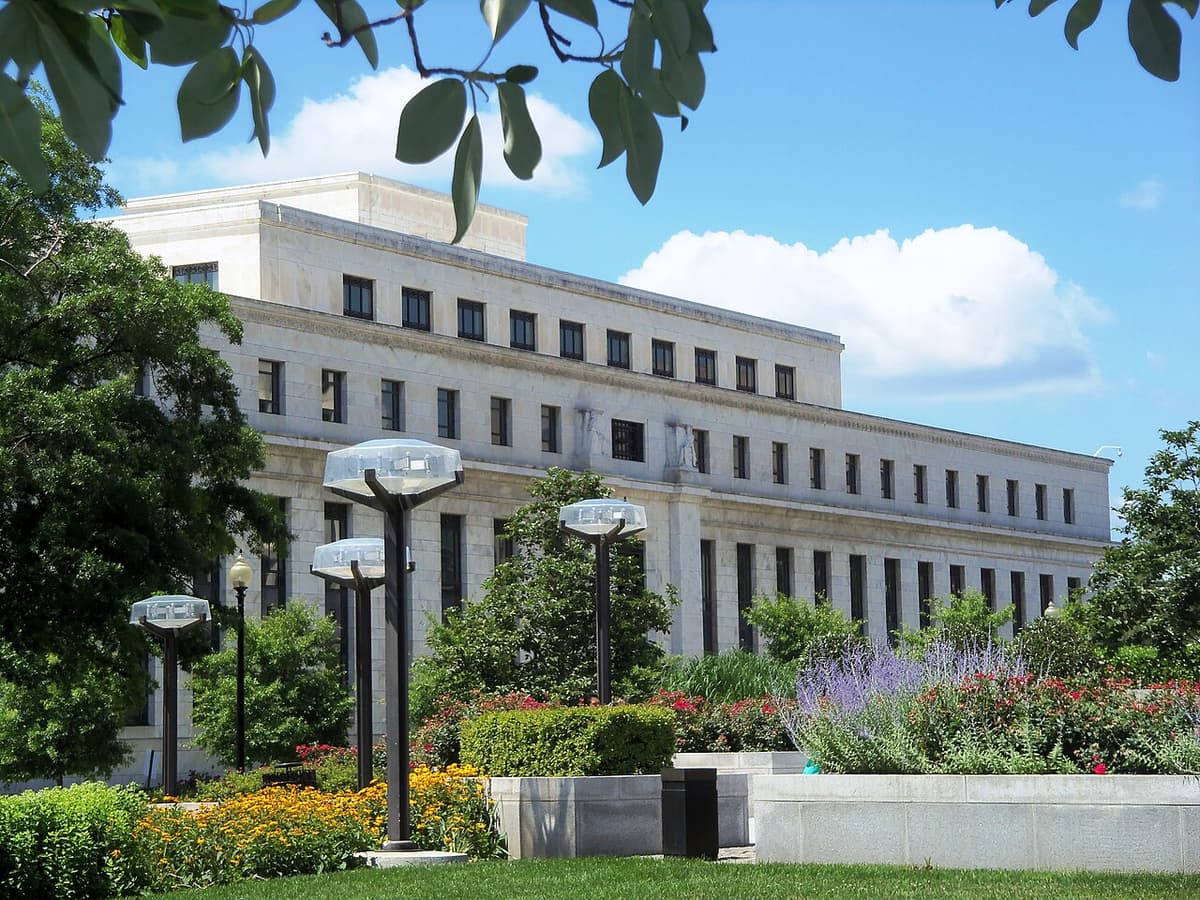
Farragutful via Wikimedia Commons CC3.0
The headquarters of the Federal Reserve at Washington, D.C. Farragutful via Wikimedia Commons CC3.0

The Federal Reserve routinely used to make a lot of money for the government. Instead it made huge losses in recent years, though generating profit is a mandate for the Fed and reflects the essence of a currency-printing central bank.

The profit arises from having been granted a monopoly in the issuance of United States dollar currency, a monopoly which operates not only in America but around the world.  Currency is zero-interest funding for the Fed, which it gets to invest in interest earning assets, generating automatic profits, most of which are supposed to in turn get sent to the Treasury.

How much profit is that? The Fed now has outstanding nearly $2.4 trillion of interest-free paper money.  If it simply invested this funding in 90-day Treasury bills, it would now be making 3.6 percent on its investment, with de minimis credit and interest rate risk and zero interest rate cost, for an annualized gross profit of $85 billion. 

The Fed reports it costs about $1 billion a year to produce the currency, so the currency monopoly alone would generate a nice, automatic annual profit of about $84 billion, mostly to send to the Treasury. That’s the fundamental central bank statutory design.

On top of that, the Fed gets a big profit gift from the Treasury, because the Treasury is maintaining extremely large zero-interest deposits with the Fed.  In the fourth quarter of 2025, this free funding for the Fed averaged about $880 billion. Invested at 3.6 percent, this would be an additional annualized profit for the Fed of $32 billion.

The Treasury has to borrow and pay interest on the money it keeps at zero interest in the Fed, so under current circumstances what creates a large profit for the Fed is an equivalent loss to the Treasury and increases the federal budget deficit.

Thus, thanks to its gifts from the Congress and the Treasury, the Fed starts off with basically risk-free profits now at a running rate of about $106 billion per year ($84 billion plus $32 billion, then subtracting its operating expenses of about $10 billion).  In Congressional intent, virtually all of this profit should be remitted to the U.S. Treasury.

This, however, is not happening. Instead, it appears that although it will have a small profit in the fourth quarter, the combined Fed will report a loss for the full year 2025 of about $19 billion. So what happened to all that more than $100 billion of automatic profit? Well, another part of the Fed, its gamble in long-term Treasury and mortgage securities, lost so much money that it wiped out all the other profit.

Financially, the Fed is divided into three parts. The first part, the  currency monopoly, always makes big profits. The second part, holding Treasury deposits,  makes big profits when the Treasury keeps huge balances in this account. It’s the third part, investing in trillions of dollars of long-term Treasury bonds and mortgage securities and funding them short, just like a giant 1980s savings and loan,  that has made the massive losses. 

The actual losses of the Fed’s third part — the losses it has imposed on the Treasury — are far greater than most people, including most financial professionals, imagine. This investment gamble has cost the U.S. Treasury over $500 billion. This is because the third part of the Fed lost all the profits of the currency monopoly and lost all the profits from holding Treasury deposits.

Specifically, from September 2022 to the end of 2025, there were total reported combined net losses of the Fed of $224 billion; plus the total currency  profits wiped out of $261 billion; plus the total profits from Treasury deposits wiped out of $95 billion. That adds up to the total losses of the investment gamble:  $582 billion.

These are my estimates from Fed published data. I think we are safe in concluding that the Fed’s investment losses exceed $500 billion. In other words, the Fed has spent over $500 billion of the taxpayers’ money on the losses of its investment gamble. Congress never approved this expenditure.

Congress never approved taking the financial risk that resulted in the loss. This is a startling effect of allowing the Federal Reserve to be “independent.” It is a policy and constitutional issue hundreds of times bigger and more important than however much the Fed may have overspent on its luxurious building renovations.


The New York Sun

© 2026 The New York Sun Company, LLC. All rights reserved.

Use of this site constitutes acceptance of our Terms of Use and Privacy Policy. The material on this site is protected by copyright law and may not be reproduced, distributed, transmitted, cached or otherwise used.

The New York Sun

Sign in or  create a free account

or
By continuing you agree to our Privacy Policy and Terms of Use