‘This Is All About the Stalking Victim’: Luigi Mangione’s Defense Makes a New Push To Get the Death Penalty Off the Table in Killing of CEO

Federal prosecutors, at the instruction of the attorney general, are seeking charges that would make it a capital case
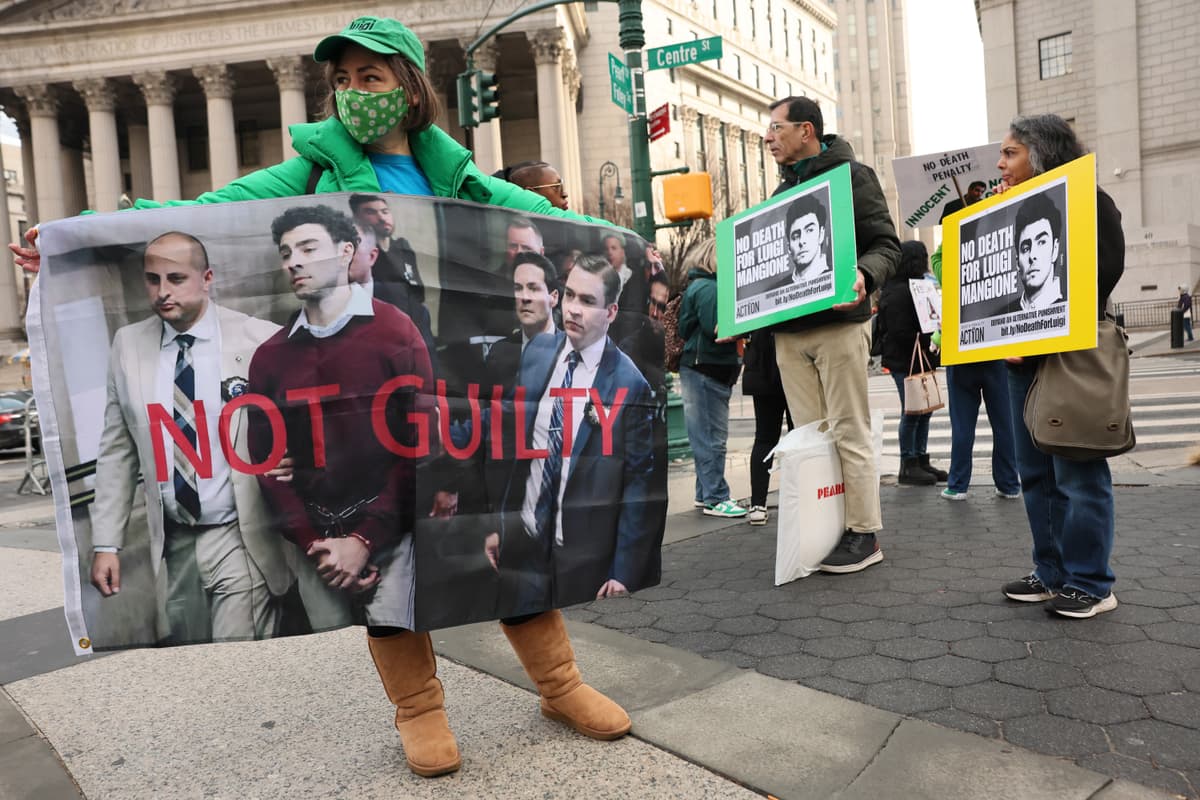

Michael M. Santiago/Getty Images
Supporters of Luigi Mangione wait in line to enter Manhattan Federal Court on January 09, 2026. Michael M. Santiago/Getty Images

Luigi Mangione, the Ivy-League graduate accused of killing the CEO of UnitedHealthcare Brian Thompson last year, appeared for a pre-trial hearing at a Manhattan federal court on Friday. The district judge did not set a definite trial date but suggested some possibilities. Jury selection for Mr. Mangione’s federal trial could begin on September 8, after labor day, or in January 2027, depending 

on whether it’s a capital trial – potentially involving the death penalty – or not. 

“It’s a difficult issue,” district judge Margaret Garnett told the parties on Friday. “I want to think about it.” 

The main purpose of Friday’s hearing had been to hear arguments over a defense motion filed in October, as the Sun reported, asking the judge to dismiss two charges from the four count indictment brought by the government against Mr. Mangione, including the charge that is death penalty eligible, “murder through the use of a firearm.” 

Mr. Mangione is being prosecuted in three separate jurisdictions for crimes relating to Thompson’s murder: in Pennsylvania, where he was arrested, in New York state court, and in federal court at the Southern District of New York. Mr. Mangione, who pleaded not guilty to all charges, is being held at the notorious Metropolitan Detention Center in Brooklyn, where the deposed Venezuelan president and his wife, Nicolas Maduro and Celia Flores, arrived last weekend.

On Friday, Mr. Mangione, 27, who wore beige prison garb and was shackled at his feet, seemed calm, and took notes throughout the proceeding that lasted about two hours and 45 minutes. 

Judge Garnett gave each side 30 minutes to present oral arguments, but due to her many questions, she allowed both sides to address the court for slightly longer. 

An attorney for Mr. Mangione, Paresh Patel, a public federal defender from Maryland, argued for the defense that both count three and count four should be dismissed over a technical legal interpretation of the statutes. Count three accuses Mr. Mangione of using a firearm to commit murder, a charge that is death penalty eligible, and count four, a firearms offense, accuses him of having used a firearm suppressor, something similar to a silencer. Federal prosecutors disagree with the defense, finding that the charges are appropriate. The attorney general, Pam Bondi, has said she wants Mr. Mangione sentenced to death.   

In their motion, the defense attorneys argued that the firearm offense is not warranted because the first two crimes, count one, “Stalking – Travel in Interstate Commerce,” and count two, “Stalking – Use of Interstate Facilities,” are not in and of themselves “crimes of violence.” 

Defense attorneys wrote that the court is required “to look at the elements of a charged statute (but not the defendant’s actual conduct) when determining whether an offense ‘categorically’ constitutes the federal definition of a ‘crime of violence,’” and they found that “the entire stalking statute fails to qualify as a crime of violence.” 

“This is all about the stalking victim,” Mr. Patel told the court. “It all goes back to the stalking victim.” 

The government accuses Mr. Mangione of having “stalked” Thompson, when he allegedly followed him across state lines to an annual investor conference that was being held at a Manhattan Hilton Hotel in December 2024. Thompson, who was attending the conference, was on his way to the hotel, when he was shot from the behind. The father of two was pronounced dead at the hospital shortly thereafter.         

The stalking statute, the judge remarked, “is written very broadly given the history of domestic violence in this country.” She gave the example, when a former husband follows his ex-wife to the supermarket, sends her an obsessive amount of flowers, inundates her with phone calls, and the woman reports the actions to the police, but is told by officers that there is nothing they can do. “The statue has been designed,” the judge said, “to try to create a remedy before someone is hurt or dead.”

An assistant U.S. attorney, Jun Xiang, who argued for the government, asked the judge to consider where a statute is “silent,” meaning that the court must “read into a state of mind” of a defendant. 

One of the key issues was the question whether or not a defendant “knowingly” engages in conduct that places a victim in reasonable fear that they are going to be harmed. Attorneys from both, and the judge named hypothetical situations to explore the legal realms of the statute, and to examine if stalking can be interpreted as a violent offense. The specifics of Mr. Mangione’s case were not discussed. 

The judge listened patiently and challenged both sides with questions and case law. At the end of the hearing, she said, she would make her ruling in a written decision. 

On Wednesday, Deputy U.S. Attorney Sean Buckley responded to a concern raised by the defense that Ms. Bondi has a conflict of interest due to her prior work as a lobbyist for Ballard Partners, a firm whose clients included UnitedHealth Group, of which UnitedHealthcare is the health insurance division, and whose CEO was Thompson.      

In a six-page filing, Mr. Buckley wrote Ms. Bondi no longer has a financial interest in Ballard Partners and nothing in Bondi’s financial disclosure form suggests any “ongoing income, distributions, partnership draws, or remuneration from Ballard Partners in any form.”

Mr. Buckley concluded that the defense had failed to show that Ms. Bondi’s decision to authorize the death penalty against their client was influenced by her relationship with Ballard Partners. 

Judge Garnett did not address the issue in court, she did however, discuss the question of what evidence could be used at trial. 

In December, the judge, presiding over Mr. Mangione’s case at Manhattan criminal court — where the Manhattan District Attorney’s Office is prosecuting the University of Pennsylvania graduate – held suppression hearings over the course of three weeks to address the defense’s claim that the contents of Mr. Mangione’s backpack – such as a 3D printed handgun and a journal –  should be precluded from trial because they were obtained unlawfully when the arresting officers from Altoona, Pennsylvania, where Mr. Mangione was arrested at a local McDonald’s five days after Thompson’s shooting, allegedly failed to follow proper police procedure and searched the bag without a warrant. The defense also sought to suppress statements Mr. Mangione made during the arrest because the officers did not read him his Miranda rights before they began asking him questions. The judge has not yet published a decision on the matter.   

On Friday, the defense addressed similar issues in federal court. But the district judge found that she did not need to schedule an evidentiary hearing to determine what evidence she would allow at trial.  

“At present I don’t think a hearing is necessary, if upon reflection, I change my mind, we’ll schedule it in the next couple of weeks,” Judge Garnett said. 

It is not clear which one of the trials, the state trial or the federal trial will go first.

The next hearing at federal court is scheduled for January 30. 


The New York Sun

© 2026 The New York Sun Company, LLC. All rights reserved.

Use of this site constitutes acceptance of our Terms of Use and Privacy Policy. The material on this site is protected by copyright law and may not be reproduced, distributed, transmitted, cached or otherwise used.

The New York Sun

Sign in or  create a free account

or
By continuing you agree to our Privacy Policy and Terms of Use