
Trump, Shying From Intervention in Iran, Risks Repeat of Obama’s ‘Red Line’ Fiasco in Syria
The president is encouraging protesters to keep on risking their lives for freedom because help is coming soon from Uncle Sam.
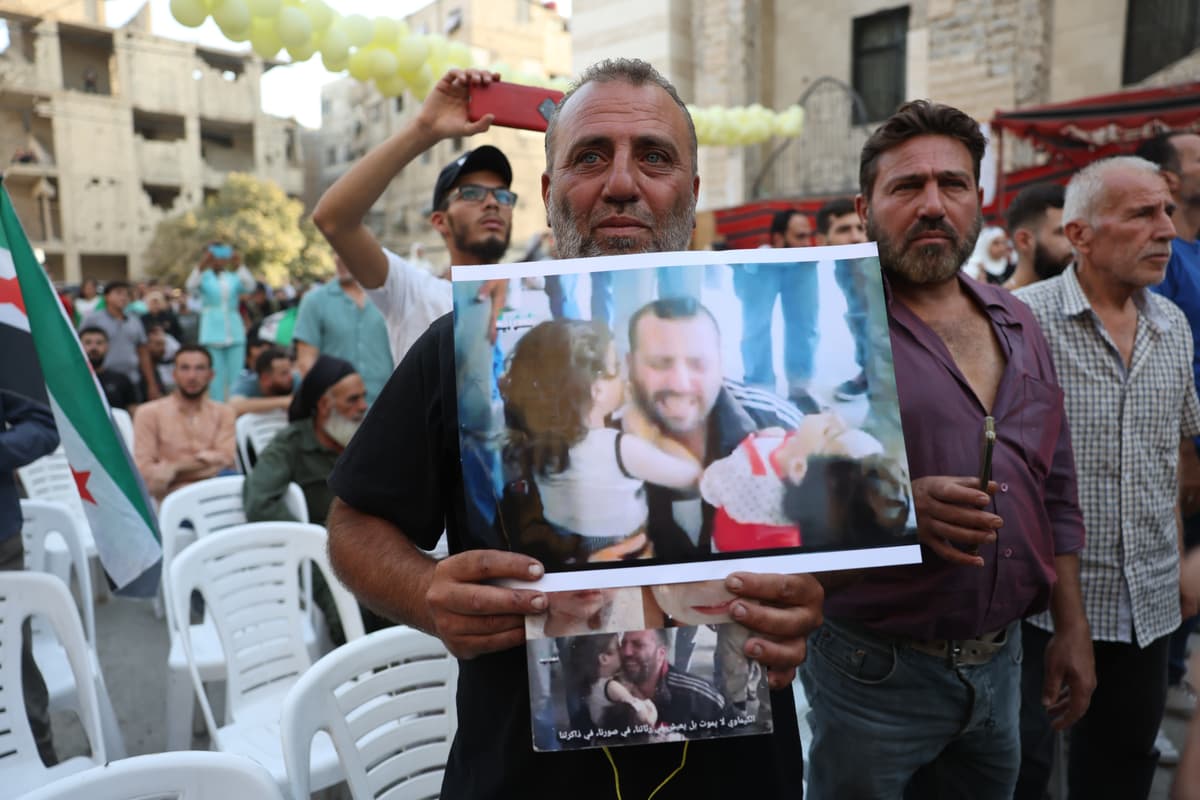
One of the most embarrassing moments of the extremely embarrassing Barack Obama presidency came in the context of the Syrian civil war. In August 2012, President Obama vowed that “a red line for us,” which would thereby necessitate some sort of American intervention, “is we start seeing a whole bunch of chemical weapons moving around or being utilized.” The 44th president continued: “That would change my calculus.”
Except it didn’t.
A year later, former Iran- and Russia-backed Syrian strongman Bashar al-Assad crossed Mr. Obama’s “red line,” launching a lethal sarin gas on his own people. Hundreds, perhaps thousands, were killed, including many children. In response, the Obama administration initially uttered a few tough words before quickly reaching a deal with Mr. Assad’s patron Russia, under which the Kremlin would be responsible for overseeing the surrender and eventual destruction of Mr. Assad’s chemical weapon stockpile. The result was a “red line” flagrantly crossed and a tremendous blow to American credibility on the world stage. Mr. Obama’s presidency never recovered.
Now, over a decade later, President Trump risks repeating Mr. Obama’s mistake. The stakes are high.
On January 2, Trump wrote on his own platform, Truth Social: “If Iran shoots and violently kills peaceful protesters, which is their custom, the United States of America will come to their rescue. We are locked and loaded and ready to go.”
He has followed up on that threat multiple times, including a post earlier this week that read: “Iranian Patriots, KEEP PROTESTING — TAKE OVER YOUR INSTITUTIONS!!! Save the names of the killers and abusers. They will pay a big price. I have cancelled all meetings with Iranian Officials until the senseless killing of protesters STOPS. HELP IS ON ITS WAY.”
It’s impossible to avoid the obvious implication of these statements: If the Islamist regime’s slaughter of its own citizens continues, America will take some unspecified — but clearly major — action to stanch the bloodshed. Mr. Trump encouraged the protesters to keep on risking their lives for freedom, in the face of wanton Islamic Revolutionary Guard Corps repression, because help is coming soon from Uncle Sam.
What’s more, the regime’s massacres have dramatically escalated since Mr. Trump’s initial warning. There are no reliable numbers, but rough estimates suggest the number of Iranians killed by the regime has risen from 500 to 600 two weeks ago to potentially as many as 20,000-plus today.
To be sure, I am not a big proponent of drawing “red lines” in foreign policy. I subscribe to the notion, advanced by Alexander Hamilton in 70 Federalist, that the advantage of executive “unity” is that “decision, activity, secrecy, and despatch will generally characterize the proceedings of one man in a much more eminent degree than the proceedings of any greater number.”
The key word here is “secrecy”: Statesmanship on the world stage and the conduct of foreign affairs is a core executive function, and it should generally be done after privately and “secretly” weighing various courses of action. “Speak softly and carry a big stick,” Theodore Roosevelt put it. He was right.
But that simply isn’t relevant anymore. Mr. Trump issued his red line. He doubled down on that red line. And the Iranian regime, which chants “death to America” on a daily basis and has even attempted to assassinate Trump, crossed that red line. Indeed, Mr. Trump’s red line hasn’t just been violated — it’s been eviscerated.
Now, Mr. Trump seems to be wavering. On Wednesday, the president commented from the Oval Office, “We have been told that the killing in Iran is stopping, has stopped. … I’ve been told that on good authority.” The same day, French press reported that Saudi Arabia, Qatar and Oman persuaded Trump to “give Iran a chance” because any American strike on Iran would lead to “serious consequences.”
Perhaps even more peculiarly, the New York Times reported on Thursday that Prime Minister Benjamin Netanyahu requested that Trump postpone any planned attack on Iran.
None of this makes much sense. Mr. Trump certainly didn’t fear any repercussions when he ordered American B-2 bombers to strike key Iranian nuclear facilities last June, following a series of initial Israeli salvos. And after following through so dramatically on his recent threats to both Nicolas Maduro in Venezuela and the Islamists slaughtering Christians in Nigeria, why would Mr. Trump now so publicly equivocate — especially when the target is a country he’s already bombed within the past year?
This seems to be coordinated kayfabe — a deliberate head fake of sorts to throw off the Iranian regime. I would wager that some sort of American action — perhaps cyber, perhaps kinetic, perhaps both — is still coming.
I would not have personally advised Mr. Trump to issue such a clarion red line threat against the mullahs. But now that he has done so, it is imperative that Trump live up to his word. His continued credibility and America’s deterrent posture both depend on it. Don’t replicate Mr. Obama’s mistake, Mr. Trump. Instead, you can become even more of a man of history than you already are.
Creators.com