On War Powers, the Constitution and Congress Prove Cobwebs Inadequate for Lassoing a Presidential Locomotive
Defining war is difficult, declaring it is rare, and making constitutional values and procedures pertinent to it is problematic.
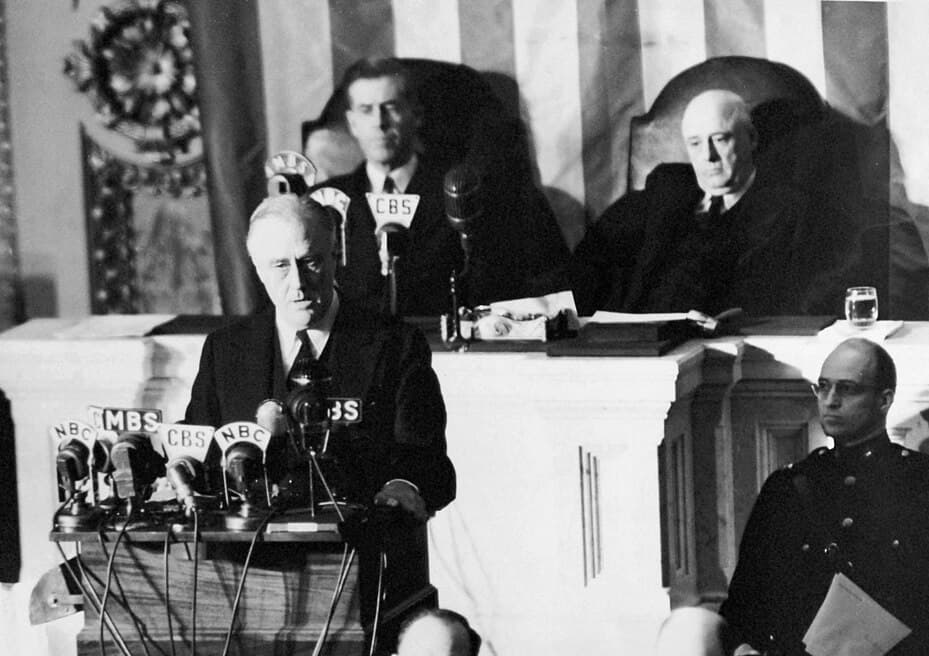
War is governmentâs gravest undertaking, but defining war is difficult, declaring it is rare, and making constitutional values and procedures pertinent to it is problematic. This has been made more so, and more urgent, by the untethering of the modern presidency from restraints other than the occupantâs constitutional conscience.
During the Revolutionary War and until the Constitutionâs ratification in 1788, the national government had no distinct executive branch. The Articles of Confederationâs weakness, and knowledge that George Washington would be the first and office-defining president, resulted in Article IIâs inherent permissiveness regarding expansions of presidential power.
In âThe President Who Would Not Be King: Executive Power Under the Constitution,â a Stanford law professor and former federal judge, Michael W. McConnell, writes that Article I vests in Congress legislative powers âherein grantedâ and enumerated. Article II simply assumes the president shall exercise all powers executive in nature. Those powers were negligible in 1789, when the executive bureaucracy was smaller than Congress. Today, executive power is everywhere.
The Constitutional Convention changed Congressâs power from âto make warâ to âto declare war,â thereby expanding presidential war power. The Convention worried that if the power to âmakeâ war belonged to Congress (which often was out of session), the president could not repel sudden attacks.
Also, the power to declare war was already almost a nullity: Most wars then (and since) were declared by beginning them â waging war before, or rather than, declaring war. In 25 Federalist, Alexander Hamilton noted that âthe ceremonyâ of formally declaring war âhas of late fallen into disuse.â Congress has not declared war since 1942 (against German allies Bulgaria, Hungary, Romania), many wars ago. Congress has, however, passed authorizations for uses of military force.
Citing decisions of self-restraint by presidents Washington (dealing with Native American tribes), John Adams (the Quasi-War with France) and Thomas Jefferson (the Barbary War), Mr. McConnell concludes that an originalist understanding of war powers is that âcongressional authorization is required before the President may employ the armed forces in offensive military operations that constitute acts of war.â
More recently, however, the Justice Departmentâs Office of Legal Counsel has, Mr. McConnell says, ârepeatedlyâ said that a military operation that is not âsufficientlyâ extensive in ânature, scope, and durationâ does not constitute âwarâ requiring congressional approval. âThis interpretation,â Mr. McConnell tartly notes, âslips the constraints of founding-era understanding based on objective questions of the law of nations, and substitutes a Goldilocks-like question about âsufficientâ extent.â
In the Founding era, Congress could control the president by not raising an army or maintaining a navy. (State militias were much larger than the national military.) Today, presidents wield huge permanent armed services, and have no âpractical needâ Mr. (McConnellâs careful phrase) to seek Congressâs permission to employ them. Mr. McConnell notes, however, that Congressâs appropriation power is âalmost unlimited,â and was wielded to end American involvement in Vietnam.
In âImperial from the Beginning: The Constitution of the Original Executive,â a University of Virginia Law School professor, Saikrishna Bangalore Prakash, says âwhatever military discretion Congress chooses not to exercise, it must leave for the president.â Beyond occasional, optional and broad authorizations for the use of military force, Congress nowadays chooses to tolerate a vast area of presidential âprerogative,â as John Locke defined it: the âpower to act according to discretionâ and âwithout the prescription of the law.â
The lesson is stark. Do not expect the Constitutionâs language and structure to impede what decades of presidential practices have made normal: presidents doing what they choose regarding warmaking. The current president has pushed prerogative to absurdity (e.g., defining war as something waged by suspected drug smugglers).
In domestic affairs (e.g., a bogus âemergencyâ justifying tariffs; an executive order amending the 14th Amendment regarding birthright citizenship), the Constitution probably soon will restrain him. Regarding warmaking, however, the Constitution, Congress and norms are cobwebs inadequate for lassoing a presidential locomotive.
So, voters are learning the Constitutionâs limited ability to mitigate the consequences of their choices. Neither the language of the law (constitutional or other), nor what are now shadows of norms, can substitute for what is indispensable: an occupant of the presidency whose constitutional conscience causes him or her to distinguish the proper from the merely possible.
Given what the foreword of Mr. McConnellâs book calls todayâs widespread sense of âconstitutional degradation,â it might seem quaint to speak of a presidentâs constitutional conscience. In a few years, however, there can again be presidential self-restraint grounded in personal humility, and in uncodified principles â moral and prudential â requiring decent respect from the decent.
The Washington Post