Why Are Arab Regimes Afraid of a Secular, Democratic Iran?

‘In the long run, an advanced, Westernized Iran could spell the beginning of the end for the dictatorships and monarchies of the Mideast,’ an Israeli entrepreneur writes.

UGC via AP
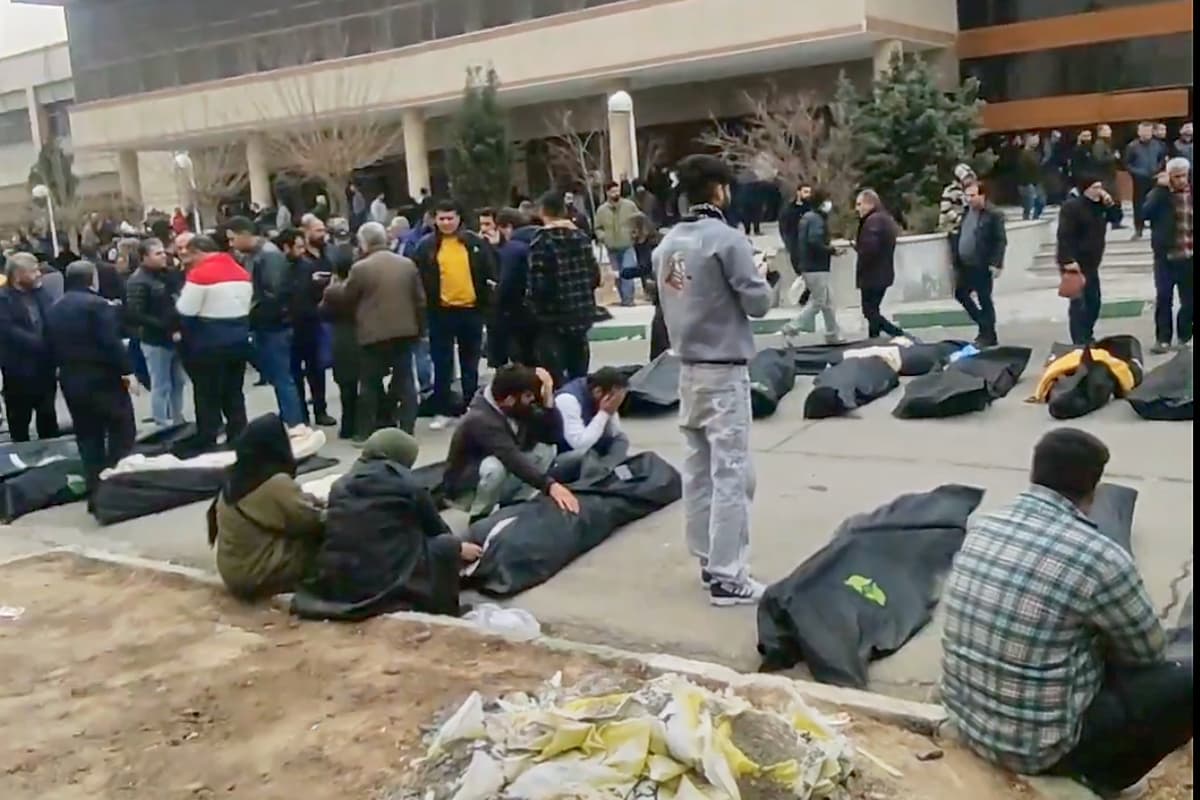
This frame grab from videos taken between January 9 and January 11, 2026, and circulating on social media shows images from a morgue with dozens of bodies and mourners after crackdown on the outskirts of Iran's capital. UGC via AP

Publicly Arab neighbors are mostly mum about the historic protests rocking Iran, while, quietly, Gulf lobbyists are urging President Trump to refrain from using force to helpanti-regime forces. Are they afraid that an end to mullah rule would endanger their own regimes?

The White House is under heavy pressure from the Gulf monarchies to forgo kinetic action against Islamic Republic targets. The most obvious explanation is a concern for an Iranian retaliation against American-allied neighbors. Yet deeper strategic fears may be at play as well.

The pressure, which also comes from some of the president’s top advisers, including Vice President Vance, may have convinced Mr. Trump to forgo military action, at least for now. “We are told that the killing in Iran is stopping” and “there’s no plan for executions” of incarcerated protesters, he said Wednesday at the White House. 

While the president’s comment could indicate that he has opted for a negotiated solution, he also urged diplomacy last June, just prior to sending B-2 bombers to strike Iran’s nuclear facilities. “Sailors remain alert and ready on watch while the Arleigh Burke-class guided-missile destroyer USS Roosevelt (DDG 80) transits the Arabian Gulf,” the Navy’s Fifth Fleet wrote in its official X account on Tuesday.

Entering the third week of the uprising, though, Islamic Republic enforcers have been using live ammunition to quash the rebellion. As many as 20,000 protesters were reportedly killed in the last few days. While anti-regime forces in Iran and abroad are encouraged by Mr. Trump’s support, they are dismayed by Iran’s immediate neighbors’ silence. 

“As Iranians are being massacred for demanding freedom, I see some Arab governments afraid to say a single word. What is their fear?” a prominent New York-based Iranian activist, Masih Alinejad, tells the Sun. “A regime change in Iran represents a turning point for the entire Middle East. Though the transition may pose short-term security risks, the long-term rewards of a friendly Iranian neighbor are immense.”

Rather than supporting such goals, though, Iran’s neighbors are urging Mr. Trump to avoid upsetting the regional apple cart. Saudi Arabia, Qatar, Oman, and other Gulf states — with the notable exception of the United Arab Emirates — have sent anxious messages to Washington to avoid military confrontation and turn to diplomacy instead.

Some Gulf countries are reportedly denying America the use of their airspace, fearing it would be used to strike Iranian targets. Personnel are being evacuated from America’s largest Mideast air base at Qatar’s al-Udeid, while American citizens are urged to leave Iran by land through Turkey or Armenia.     

Further escalation “would have catastrophic results in the region and beyond and therefore we want to avoid that as much as possible,” a spokesman for Doha’s foreign ministry, Majed al-Ansari, told reporters on Wednesday. Qatar, he added, is working to mediate an end to the crisis.  

“The Gulf leaders are satisfied with the status quo,” the head of the Jerusalem Center for Security and Foreign Affairs, Yossi Kuperwasser, tells the Sun. “They are afraid that an Iranian retaliation would target them. They also prefer a weakened Iran that is consumed by internal turmoil, which is unlikely to threaten them.”

The Arab regimes, in addition, are concerned about “elements at home that might push for democratization,” Mr. Kuperwasser, a former general at the Israel Defense Force intelligence unit, adds.       

The Iranian regime’s pursuit of nuclear arms and its efforts to export its Islamic revolution to the Middle East and beyond led to global sanctions. Those are forcing Tehran to sell illicit oil and gas, mostly to Communist China, at a discount rate. Internal oppression has forced many of Iran’s most brilliant minds to flee the country.

Five top financial institutions have reportedly collapsed or are about to collapse. Those include Sepah Bank, where members of the Islamic Revolutionary Guards Corps that are responsible for quashing street protests keep their money. 

On Iranian streets the profile of the exiled son of the Shah, Reza Pahlavi, is rising as a new generation is yearning for the pre-Islamic Republic era and an alliance with America. Would Arab regimes welcome such a trend?

The Saudi and Qatari reaction to the growing crisis betray their fear of a “westernized Iran,” an Israeli-born business entrepreneur and author, Eran Efrat, writes on X. Iran is a “dormant empire” with vast natural resources and “brains that would return home once the country is ruled by a western-style government.”

Iran could emerge as a top competitor to Qatar, Saudi Arabia, and the rest, Mr. Efrat writes. “In the long run, an advanced, Westernized Iran could spell the beginning of the end for the dictatorships and monarchies of the Mideast.”


The New York Sun

© 2026 The New York Sun Company, LLC. All rights reserved.

Use of this site constitutes acceptance of our Terms of Use and Privacy Policy. The material on this site is protected by copyright law and may not be reproduced, distributed, transmitted, cached or otherwise used.

The New York Sun

Sign in or  create a free account

or
By continuing you agree to our Privacy Policy and Terms of Use