
Will a New Mideast War Erupt Over Iran’s Growing Ballistic Missile Arsenal?

‘The threat is significant, and needs to be confronted soon, but we must do it in consultation with America and with its backing,’ a former Israeli intelligence official tells the Sun.

AP/Evan Vucci
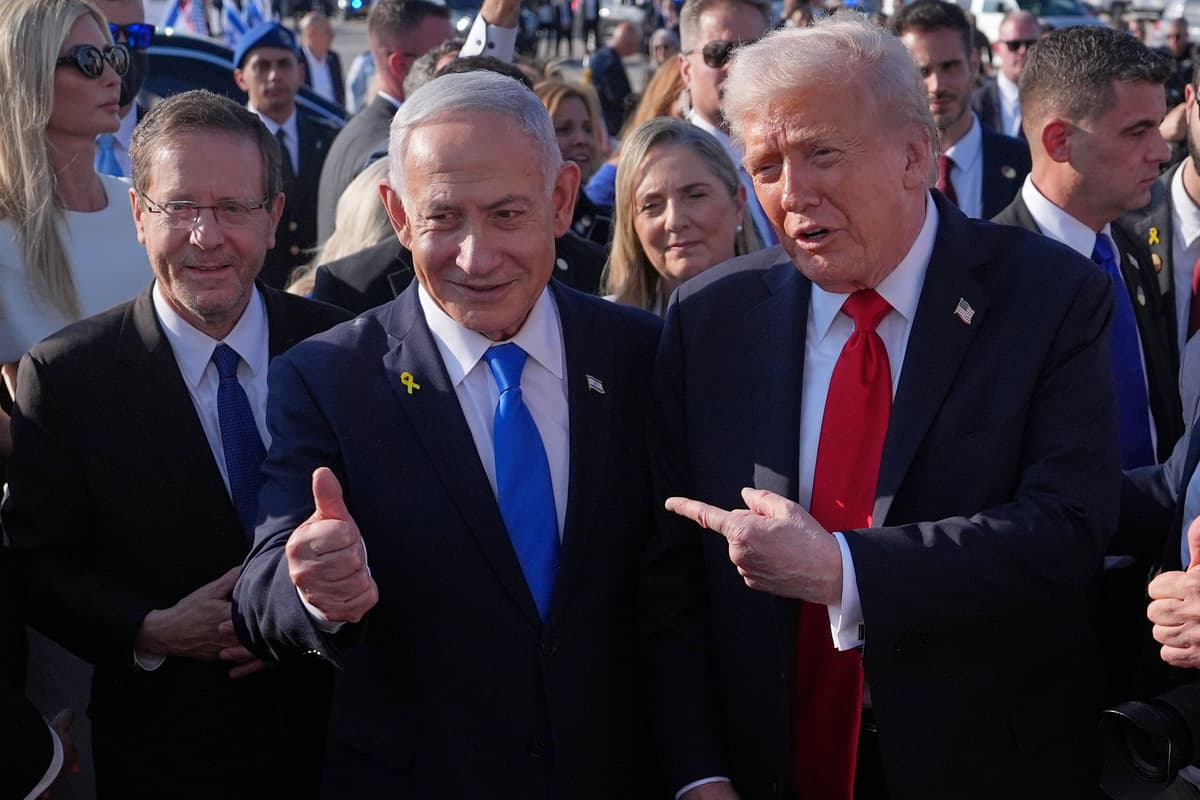
President Trump with Prime Minister Benjamin Netanyahu at Ben Gurion International Airport, October 13, 2025. AP/Evan Vucci

As Prime Minister Benjamin Netanyahu prepares for a trip to Florida, Israeli officials and their Washington supporters are highlighting Iran’s efforts to rebuild a ballistic missile arsenal. Could a military operation to remove the threat be launched as soon as early 2026?

Mr. Netanyahu is scheduled to visit President Trump at Mar-a-Lago on December 29. Meeting the Israeli premier this Sunday at Jerusalem, Senator Lindsey Graham, an Iran hawk, joined top Israeli officials in warning of the danger Iran’s missiles pose to Israel and America.

As if on cue, Iran conducted multi-city ballistic missile drills over the weekend. Missile tests were observed at Tehran, Isfahan, Mashhad, Khorramabad, and Mahabadas, a London-based website, Iran International, reported on Monday.

“They’re producing ballistic missiles in Iran at a very high number,” Mr. Graham told Israel’s I-24 television on Sunday. “I think the next attack, if there is an attack, would be focused on their ballistic missile capability.” He added: “Anything that weakens Israel weakens America.”

While a war over Iran’s missiles is unlikely in the immediate future, “the threat is significant, and needs to be confronted soon,” the head of the Jerusalem Institute for Strategy and Security, Yossi Kuperwasser, tells the Sun. “We must do it, though, in consultation with America, and with its backing,” the former top military intelligence brigadier general says.   

Realistically, an American-backed Israeli operation in Iran, if at all, could only happen early next year. After that, America enters a political season ahead of next November’s midterm polls. Israel is also scheduled to conduct a national election in the second half of next year.

Publicly, Mr. Trump frequently insists that America and Israel in June “obliterated” Iran’s nuclear arsenal. He rarely addresses the threat that conventional arms, including ballistic missiles, pose to Israel and to American forces in the region. 

“Ballistic missiles form a core part of the Islamic Republic’s deterrent strategy, and have only grown in importance since the 12-day war,” an Iran watcher at the Foundation for Defense of Democracies, Behnam Ben Taleblu, tells the Sun. “What is happening now, however, is that the regime is trying to build back better in the conventional military realm without getting caught. The why should be obvious: No one knows how exposed the regime is than the regime itself.”

Tehran officials insist that the rebuilding of its missile arsenal is being done only for defensive purposes. “The Iranian ballistic program was developed to defend Iranian territory and not to be the subject of negotiations,” the Islamic Republic’s foreign ministry spokesman, Esmail Baghaei, said Monday. 

Yet the Israel Defense Force chief of staff, Lieutenant General Eyal Zamir, reportedly warned the U.S. central command commander, Admiral Bradley Cooper, that intelligence indicates that the Iranian missile exercises could be a cover for a sneak attack on Israel.

“Following October 7, no one is immune,” Defense Minister Israel Katz, says, adding that he had instructed the IDF to prepare to confront any Iranian provocation.

Some at Jerusalem and Washington say, though, that the missile threat is manageable. “Sure, the Iranians are rebuilding their missile arsenal, as we do, by the way, with our aerial defenses, but conventional missiles are far from an existential threat,” a veteran missile and space researcher, Tal Inbar, tells the Sun.

“Iran will not launch 1,000 or 2,000 missiles in one salvo, and they don’t manufacture 3,000 missiles in a year, and certainly not in one month,” Mr. Inbar says. He referred to reports on NBC and Al Aarabiya that cited unidentified Israeli and American sources claiming that such acceleration in Iran’s domestic production of ballistic missiles and drones is taking place. 

During the 12-day war in June, Iran is believed to have lost half of its arsenal of an estimated 3,000 ballistic missiles. In the first hours of the war the IDF disabled the bulk of Iran’s air defenses, which allowed its air force to fly unmolested in the enemy country’s airspace. It destroyed at least 1,000 Iranian ballistic missiles and dozens of launchers. Iran, at the same time, shot more than 500 missiles during the war, nearly 90 percent of which were intercepted by Israel’s multi-layer aerial defense systems.

Iranian officials, though, emphasize the damage these missiles inflicted on Israeli cities, as well as military and key infrastructure targets. Only a small fracture of the Iranian missiles escaped Israeli and American anti-missile batteries stationed in the country. Yet buildings at the center of Tel Aviv and some of its suburbs were demolished, as were sites in the north and south of Israel, including a hospital at the southern city of Beer-Sheba. 

“Iran’s missiles, manufactured by our elite, penetrated all of the occupation’s expensive air defense systems and destroyed vital targets in Israel,” a spokesman for the Iranian armed forces, Brigadier General Abolfazl Shekarchi, bragged.

The Islamic Republic’s bark, though, might be louder than its bite. “They are preparing the last war,” an Iran watcher at Israel’s Misgav Institute, Yossi Mansharof, says. “They are disappointed with the extent of promised Chinese and Russian help. Israel-surrounding proxies were weakened significantly. The only thing Iranians have left is the missile project, which can’t paralyze Israel.”

A “miscalculation,” though, could lead to a full scale war, a top military analyst at Israel’s N-12 television, Nir Dvori, says. The Iranians, he says, fear that Israel is preparing for the next round, and after October 7, 2023, no one in Israel wants to be again taken by surprise.     

The threat of war is likely to loom over the Middle East as long as the mullahs remain in power at Tehran. Is it time, then, for regime change? “I think the people of Iran will do it,” Mr. Graham says. “I want to weaken the Iranian regime. They’re a fanatical regime. They’re religious zealots. They’re religious Nazis. They oppress their own people.” 

Yet the senator, who often speaks to Mr. Trump, says he is not proposing an American invasion of Iran. Mr. Graham adds: “I’m advocating that we hit them militarily when they begin to show signs of regenerating their nuclear program or their missile program.”


The New York Sun

© 2025 The New York Sun Company, LLC. All rights reserved.

Use of this site constitutes acceptance of our Terms of Use and Privacy Policy. The material on this site is protected by copyright law and may not be reproduced, distributed, transmitted, cached or otherwise used.

The New York Sun

Sign in or  create a free account

or
By continuing you agree to our Privacy Policy and Terms of Use