
Congressional Redistricting Moves Forward in Indiana Senate

The election committee passed the bill after four hours of public comment but its fate in the full state senate remains uncertain.

AP/Michael Conroy
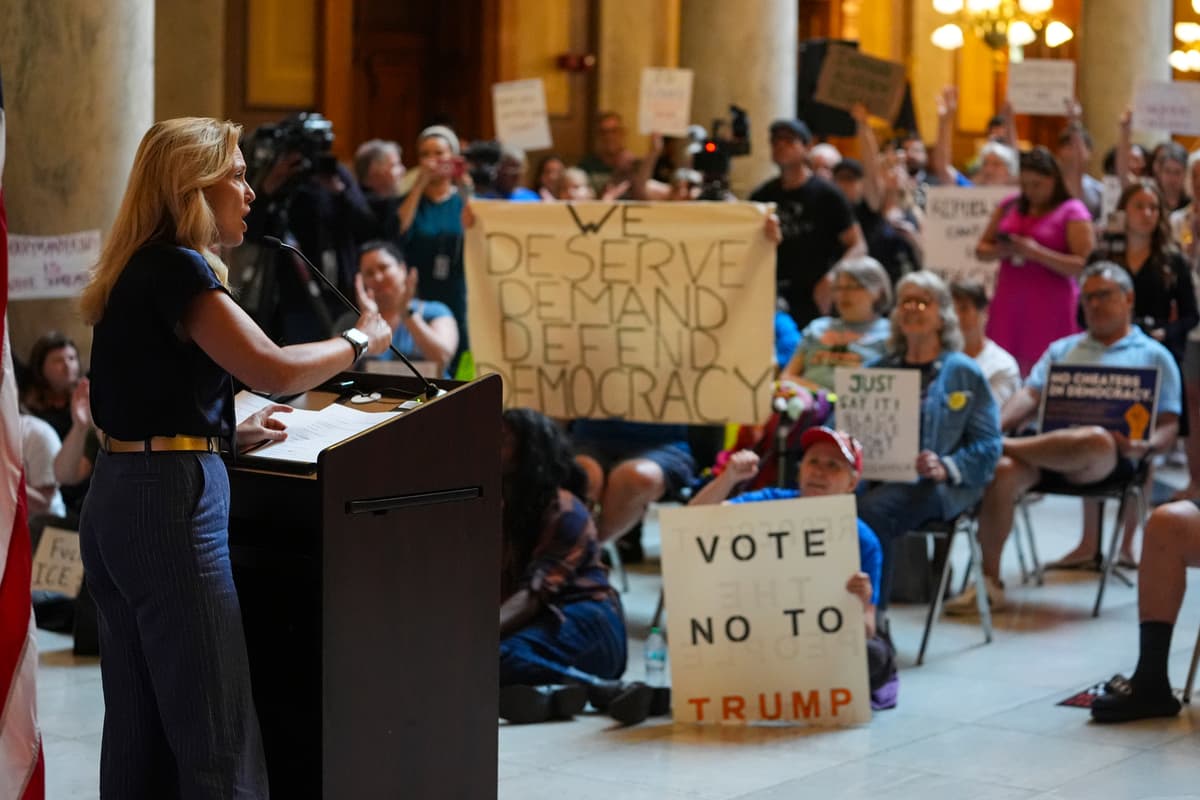
State Senator Shelli Yoder speaks at a rally protesting redistricting at the Statehouse in Indianapolis. AP/Michael Conroy
LUKE FUNK
LUKE FUNK

An Indiana state senate committee advanced a redistricting bill Monday evening after a marathon session that aims to create additional Republican-friendly voting districts, but the plan faces an uncertain future in the full chamber.

The election committee passed the bill by a 6-3 vote after more than four hours of public comment — much of it urging lawmakers to vote down the proposal. One Republican, State Senator Greg Walker, voted “no” with the two Democrats on the committee.

“I fear for this institution,” Mr. Walker said in an emotional speech prior to the vote. “I fear for Indiana and all states if we allow intimidation and threats to become the norm.”

Three of the Republicans that voted in favor of moving the bill forward said they wanted all of the senators to be able to vote on the bill — indicating they might vote differently on the Senate floor.

Indiana is the latest Republican-controlled state that is heeding President Trump’s call to attempt to redistrict in an effort to block Democrats from taking control of the United States House of Representatives in next year’s midterm elections.

The mid-decade redistricting would most likely flip two Democratic House seats leaving Republicans likely to control all nine of the state’s congressional districts.

The map splits Indianapolis four ways and incorporates the various sections into larger Republican-leaning suburban districts. Democrats claim the new map will dilute the power of black voters. The bill’s sponsor, Representative Ben Smaltz, has carefully framed the redistricting as simply to create a partisan advantage and is not motivated by racial gerrymandering, which could draw legal challenges.

The plan sailed through the Indiana House of Representatives 57-41 but the Senate’s Republican leader, Rodric Bray, has insisted that there is not enough support to pass the redistricting plan in his chamber.

As the Senate was gaveled into session on Monday, protesters against redistricting chanted “Vote no” in the hallway outside of the chamber.  More than 100 citizens signed up to testify at the election committee hearing. Comments were limited to two minutes a person due to the number of people who wanted to speak. The majority spoke out against redistricting.

The plan needs 25 votes to pass the state senate. So far, only 16 GOP senators have confirmed they are yes votes for the full Senate vote on Thursday.

At least 14 Republicans have publicly stated they will vote no.

“I think the maps are pretty alarming, actually. So I was a no before, and I’m for sure a no now,” State Senator Mike Crider, a Republican, told the Capital Chronicle. “I mean, I just think that if those maps pass, there’s a good possibility that three or four millionaires from Indianapolis will represent a third of the state, so I don’t know that that serves us well.”

President Trump has promised to support primary challengers against any Senate Republicans who are against redistricting and the political action arm of Charlie Kirk’s Turning Point organization says it will partner with other PACs to defeat Republican defectors.

The Supreme Court is allowing Texas to use its newly drawn congressional maps for the 2026 elections. Last week’s decision was 6–3, with all conservative justices voting to let the maps take effect.

Missouri, North Carolina, and Ohio have also approved new voting maps that are expected to favor Republican candidates. Each of those states is expected to pick up one Republican seat.

Democratic-controlled states have started their own redistricting plans to counter the Republicans. California voters approved a gerrymandered map that is expected to favor Democrats. Illinois, Maryland, and Virginia are also considering Democratic-favored redistricting.

The end result could be a string of states with more single-party dominance but little change to the overall balance of power in Congress.


The New York Sun

© 2025 The New York Sun Company, LLC. All rights reserved.

Use of this site constitutes acceptance of our Terms of Use and Privacy Policy. The material on this site is protected by copyright law and may not be reproduced, distributed, transmitted, cached or otherwise used.

The New York Sun

Sign in or  create a free account

or
By continuing you agree to our Privacy Policy and Terms of Use