
India’s Modi, Amid Heated Disagreement With Trump Over Tariffs, Will Forgo Joining a China-Led Anti-American Coalition
Trump has taken several steps to denigrate America’s democratic ally, yet India’s leader will not be present as Communist China flexes its muscle in a military parade.
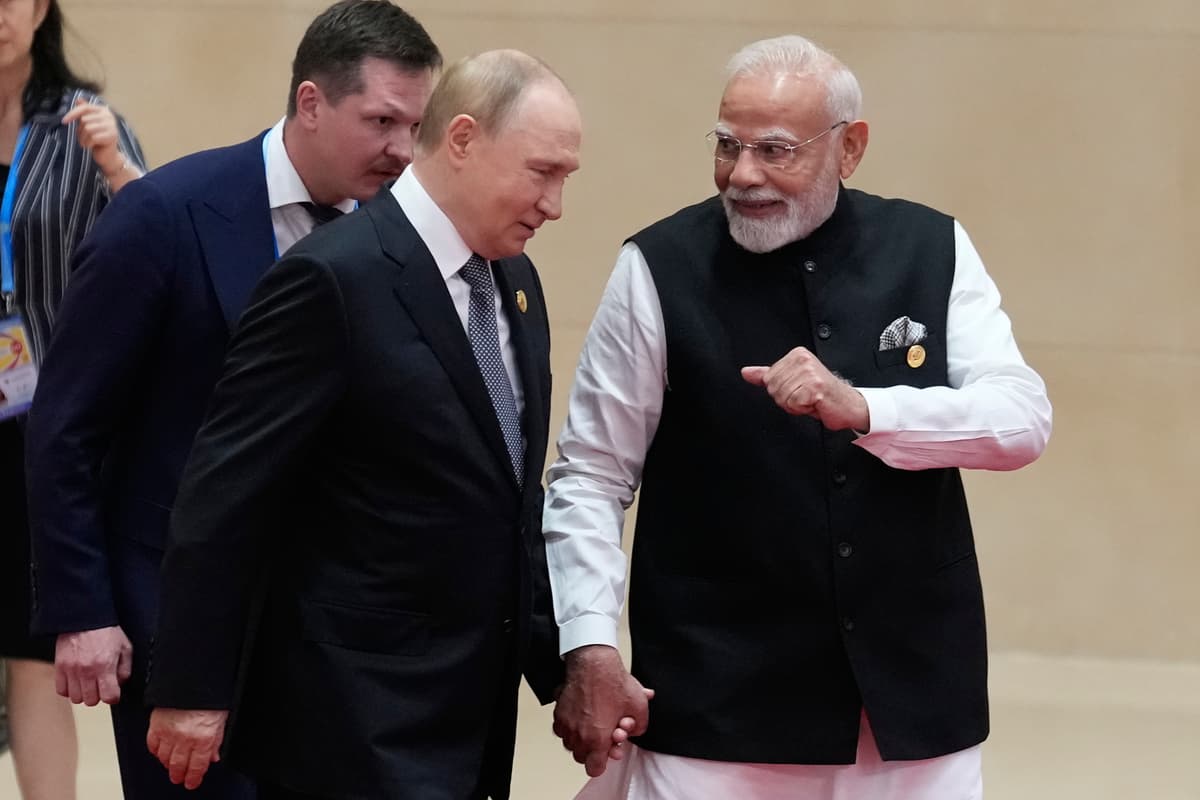
President Vladimir Putin, the North Korean dictator, Kim Jong-un, President Masoud Pezeshkian, and more than 20 other world leaders will join Chairman Xi Jinping Wednesday as Communist China flexes its muscle in a military parade. In contrast, Prime Minister Narendra Modi, who made a splash during the weekend’s Shanghai Cooperation Organization summit, will be absent on the parade’s reviewing stage.
The SCO summit is perceived as Mr. Xi’s attempt at passing a global leadership torch to Communist China and Asia, from America and the West. Mr. Modi’s participation in the bash included a first one-on-one meeting in seven years with the Beijing leader and a photo of him smiling alongside Messrs. Xi and Putin. It was widely seen as India’s pushback against President Trump, who has taken several steps to denigrate America’s democratic ally.
The Indian leader’s early return to Delhi on Tuesday attests to the limits of a possible new alliance, if any, between India and Communist China. Mr. Modi will be home during the heavily armed spectacle marking the 80th anniversary of victory over imperial Japan, which in fact is Mr. Xi’s attempt to prove his country’s military is more powerful than America’s.
“Asian countries do their signaling in different ways,” a watcher of the continent at the Foundation for Defense of Democracies, Cleo Paskal, tells the Sun. “So yes, Modi went to the SCO meeting, but no, he didn’t stand on the platform for the military parade.”
New Delhi clearly is angry with Washington. Mr. Trump has levied higher tariffs on the world’s most populous country than on almost any other, including China. He has bragged of forcing an ally to settle for a cease-fire in a clash with Pakistan, and showered gifts on India’s neighbor and adversary at Islamabad.
While anger grows at the “mercurial” American president, Indians nevertheless caution against overinterpreting a Delhi-Beijing rapprochement, or a Sino-Indian tight alliance soon.
“We have a whole lot of issues with China, not one, but a whole lot of issues, but we have to stabilize the relationship,” the executive editor of the Hindustan Times, Shishsir Gupta, tells the Sun. From Beijing’s support of Pakistan to the Chinese claim to the Indian state of Arunachal Pradesh, relations have long been stressed, he says. “So how can we have a relationship with China against the U.S.?”
Rather, Mr. Modi’s limited goal in his meeting with Mr. Xi was mostly to calm the more than 2,100-mile border between the countries, where deadly clashes have occasionally flared for years. Mr. Modi is trying to build on last month’s agreement between India’s national security adviser, Ajit Dova, and his Beijing counterpart, Wang Yi, who resolved to try to “demarcate the border on wherever there was minimum contentious issues,” Mr. Gupta says.
For India, Ms. Paskal says, “China is the long-term threat, but the U.S. is a short-term threat.” Delhi, she adds, had a lot of expectations for tightened relations with America in the second Trump presidency. They were dashed when rather than finalizing a trade deal, the president slapped India with 50 percent tariffs for its purchase of Russian oil.
“There’s a lot of anger, and part of that is they have such high expectations,” Ms. Paskal says of the Indian leadership. “As my dad always said, happiness is the difference between expectation and accomplishment.”
Mr. Trump is slapping tariffs on India for its dealings with Russia while to date he has refrained from similarly punishing Communist China, which is buying more oil from Russia than India does, or Europe, which uses Russian energy too. The decision to amass new tariffs on India all but ended Washington-Delhi trade talks.
In trade negotiations Delhi has reportedly offered a pact in which the two countries would impose zero tariffs on several key goods. Yet, Mr. Trump is accusing India of sabotaging trade talks. “India has charged us, until now, such high tariffs, the most of any country, that our businesses are unable to sell into India,” he wrote Monday on Truth Social, adding that the trade talks have been “a totally one-sided disaster.”
For now, and likely for the foreseeable future, Delhi is unlikely to play second fiddle in a Beijing-led anti-American coalition. Yet, growing tensions between Messrs. Trump and Modi, who were once seen as personal friends and allies, might weaken America’s prospects of enlisting a natural democratic ally for the competition with our most formidable adversary.