
Trump, European Officials Agree on Framework for New Deal Averting Maximum Tariffs Between Globe’s Biggest Trade Partners

The make-or-break talks head off trade penalties that could have sent shock waves through economies around the globe.
AP/Jacquelyn Martin
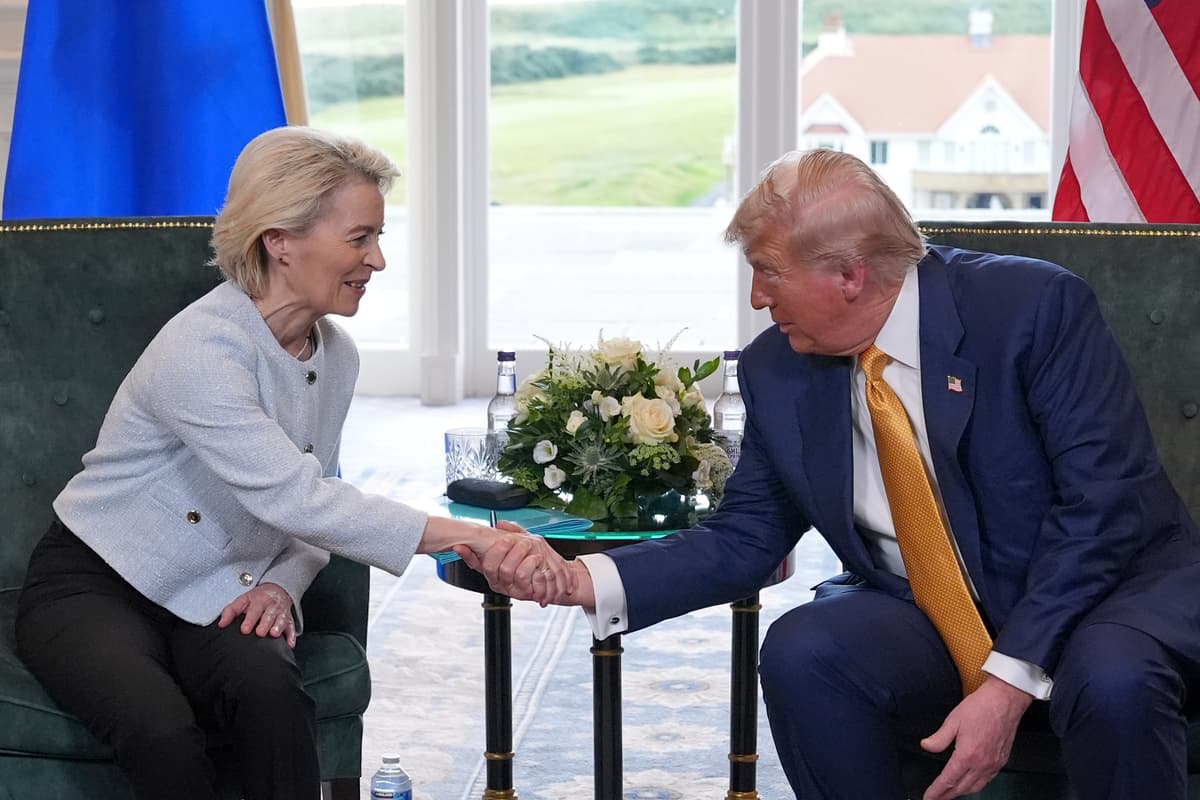
President Trump with European Commission President Ursula von der Leyen at the Trump Turnberry golf course in Scotland. AP/Jacquelyn Martin

The United States and the European Union announced that they have agreed on the framework for a tariff deal after a brief meeting between President Trump and European Commission chief Ursula von der Leyen. A White House deadline was days away for imposing punishing import taxes on the 27-member EU, which is America’s leading global trading partner.

“It was a very interesting negotiation. I think it’s going to be great for both parties,” Mr. Trump said.

The make-or-break talks were meant to head off trade penalties — and promised retaliation from Europe — that could have sent shock waves through economies around the globe.

Mr. Trump and Ms. von der Leyen held private talks at one of Trump’s golf courses in Scotland, then emerged a short time later saying they had reached an “across the board” agreement.

In remarks before the session, Mr. Trump pledged to change what he characterized as “a very one-sided transaction, very unfair to the United States.”

“I think the main sticking point is fairness,” he said while also noting, “We’ve had a hard time with trade with Europe, a very hard time.”

Ms. von der Leyen had said the United States and EU combined have the world’s largest trade volume, encompassing hundreds of millions of people and trillions of dollars. Mr. Trump said the stakes involved meant of making a deal, “We should give it a shot.”

Ms. von der Leyen said Mr. Trump was “known as a tough negotiator and dealmaker” which caused the president to interject with “but fair.” She said that, if the framework is successful, “I think it would be the biggest deal each of us has ever struck.”

For months, Mr. Trump has threatened most of the world with large tariffs in hopes of shrinking major trade deficits with many of America’s key trading partners. More recently, he had hinted that any deal with the EU would have to “buy down” the currently scheduled tariff rate of 30 percent.

The Republican president pointed to a recent agreement with Japan that set tariff rates for many goods at 15 percent and suggested the EU could agree to something similar.

Asked if he would be willing to accept tariff rates lower than that, Mr. Trump said “no.” As for the threat of retaliation from the Europeans, he said: “They’ll do what they have to do.”

Their meeting came after Mr. Trump played golf for the second straight day at his Turnberry course, this time with a group that included sons Eric and Donald Jr. The president’s five-day visit to Scotland is built around golf and promoting properties bearing his name.

A small group of demonstrators at the course waved American flags and raised a sign criticizing Britain’s prime minister, Keir Starmer, who plans his own Turnberry meeting with Mr. Trump on Monday. Other voices could be heard cheering and chanting “Trump! Trump!” as he played nearby.

On Tuesday, Mr. Trump will be in Aberdeen, in northeastern Scotland, where his family has another golf course and is opening a third next month. The president and his sons plan to help cut the ribbon on the new course.

The deadline for the Trump administration to begin imposing tariffs has shifted in recent weeks but is now firm, the administration insisted.

“No extensions, no more grace periods. August 1, the tariffs are set, they’ll go into place, Customs will start collecting the money and off we go,” U.S. Commerce Secretary Howard Lutnick told “Fox News Sunday.” He added, however, that even after that “people can still talk to President Trump. I mean, he’s always willing to listen.”

Without an agreement, the EU said it was prepared to retaliate with tariffs on hundreds of American products, ranging from beef and auto parts to beer and Boeing airplanes.

If Trump eventually made good on his threat of tariffs against Europe, it could have meant that everything from French cheese and Italian leather goods to German electronics and Spanish pharmaceuticals would be more expensive in the United States.

The United States and Britain, meanwhile, announced a trade framework in May and a larger agreement last month during the Group of Seven meeting in Canada. Mr. Trump says that deal is concluded and that he and Mr. Starmer will discuss other matters — though the White House has suggested it still needs some polishing.


The New York Sun

© 2025 The New York Sun Company, LLC. All rights reserved.

Use of this site constitutes acceptance of our Terms of Use and Privacy Policy. The material on this site is protected by copyright law and may not be reproduced, distributed, transmitted, cached or otherwise used.

The New York Sun

Sign in or  create a free account

or
By continuing you agree to our Privacy Policy and Terms of Use