

‘David’ Is an Animated Tribute to Israel’s Greatest King — and the Untapped Possibilities of Films of Faith 

A new telling does for the slayer of Goliath what ‘Prince of Egypt’ did for the liberator from Egypt.
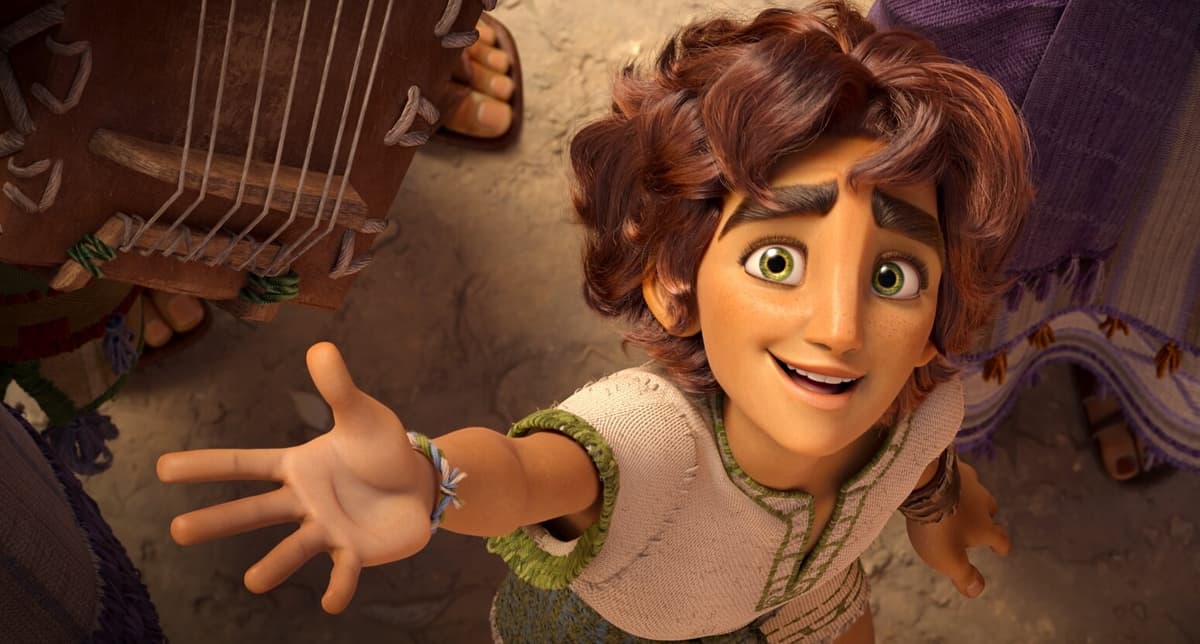
Via Angel Studios
Brandon Engam as the voice of the young David, 2025. Via Angel Studios

Some of Prime Minister Benjamin Netanyahu’s most ardent supporters have been known to chant “Bibi, King of Israel, lives and endures.” The original song, though, refers not to the Israeli premier but to the ancient king of Israel, David, and, tradition has it, the Psalmist to boot. Now comes “David,” an animated movie from a Christian studio that tells the story of David’s rise. Pitched to the young, it offers a fresh take on a timeless tale.

Few of the Bible’s characters are drawn as vividly and with as much palpable love as David son of Jesse, a shepherd as adroit with a harp as a crook. We hear about David before we see him, as the prophet Samuel tells Israel’s first king, Saul, that “the LORD hath sought him a man after His own heart, and the LORD hath appointed him to be prince over His people.” David soothes Saul’s tormented soul — and soon replaces him as God’s anointed sovereign. 

“David” is a product of Angel Studios, a Mormon-founded  enterprise whose mantra is “Family. Faith. Freedom.” The film, which follows a mini series, is directed by Phil Cunningham and Brent Dawes. Credit for the movie’s gorgeous look goes to the Cape Town-based Sunrise Animation Studios, and audiences are responding. The screening this critic attended was packed, and box office receipts have, like David, with his slingshot, punched above their weight.

The Times allows that “David” looks “magnificent” but brushes off the film as a “preachy and po-faced movie.” Astonishingly, the Gray Lady’s reviewer writes “I hesitate to criticize the source material” — meaning the Bible — “but ‘David’ has a serious problem with plotting.” That’s like saying that Shakespeare struggled to scribble a sonnet. The story of David is, alongside that of Joseph, one of the Bible’s best for sheer human drama married to literary flair.

David hugs Saul in 'David,' 2025.
David hugs Saul in ‘David,’ 2025. Via Angel Studios

The glory of David’s rise is braided with the tragedy of Saul’s fall, precipitated by his demural from the duty to destroy Amalek. The words Samuel speaks to Saul millennia ago still land like a blow to the solar plexus. Quoth the prophet: “Because you have rejected the word of the LORD, He has also rejected you from being king … ‘The LORD hath rent the kingdom of Israel from thee this day, and hath given it to a neighbor of thine, that is better than thou.” 

Given that “David” is pitched to a younger audience these weighty themes are handled with a light touch. We first meet the future king while he is tending sheep rendered with adorable anthropomorphism, and David himself is more rascal than regent. Christian artists lend their melodies to ear worms (soul sounds?) like “Follow the Light,” “Shalom,” and “Why God-My God.” His unruly locks — David was a redhead — are practically a halo.

A showstopper is the confrontation between David and the Philistine champion, Goliath. The Bible reports that he “had a helmet of brass upon his head, and he was clad with a coat of mail; and the weight of the coat was five thousand shekels of brass.  And he had greaves of brass upon his legs, and a javelin of brass between his shoulders.  And the shaft of his spear was like a weaver’s beam; and his spear’s head weighed six hundred shekels of iron.”

David, though, “prevailed over the Philistine with a sling and with a stone, and smote the Philistine, and slew him; but there was no sword in the hand of David.” That climax comes early in the film, and early in David’s life. That triumph, though, precipitates tsuris, as Saul’s jealousy is triggered by David’s success. Even what another sweet singer of Israel, Leonard Cohen, called David’s “secret chord that pleased the Lord” is not enough to stave off conflict. 

“David” ably conveys the sine curve of Saul’s moods, which are warped by a “distressing spirit of the Lord.” Twice Israel’s first king hurls a spear at David while the younger man is strumming his harp. Less inconstant is the love between David and Saul’s son Jonathan, whom the Bible reports “made a covenant with David, because he loved him as his own soul.” Both Saul and Jonathan are ultimately slain by the Philistines on Mt. Gilboa. 

When David hears that the House of Saul has fallen he composes one of the greatest elegies ever written: “Tell it not in Gath, publish it not in the streets of Ashkelon; lest the daughters of the Philistines rejoice, lest the daughters of the uncircumcised triumph … Saul and Jonathan, the lovely and the pleasant in their lives, even in their death they were not divided; they were swifter than eagles, they were stronger than lions. Ye daughters of Israel, weep over Saul.”

Even as a viewer appreciates this film’s intentions, he might wonder about the possibilities available for a more mature treatment of David. His  life comes to be streaked with tragedy. Tradition has it that the messiah will descend from David, yet his life was marred by perpetual war, a catastrophic sin with Bathsheba, and the betrayal of his sons. Ultimately, God rules that David’s son Solomon, not his father, is suitable to build His Temple.


The New York Sun

© 2026 The New York Sun Company, LLC. All rights reserved.

Use of this site constitutes acceptance of our Terms of Use and Privacy Policy. The material on this site is protected by copyright law and may not be reproduced, distributed, transmitted, cached or otherwise used.

The New York Sun

Sign in or  create a free account

or
By continuing you agree to our Privacy Policy and Terms of Use