
‘Dead Man’s Wire’ Recreates a Little-Known, Harrowing Hostage Situation From 1970s America
While underwhelming in some aspects, the real-life nature of the case and tension throughout keep one interested and even riveted at times.
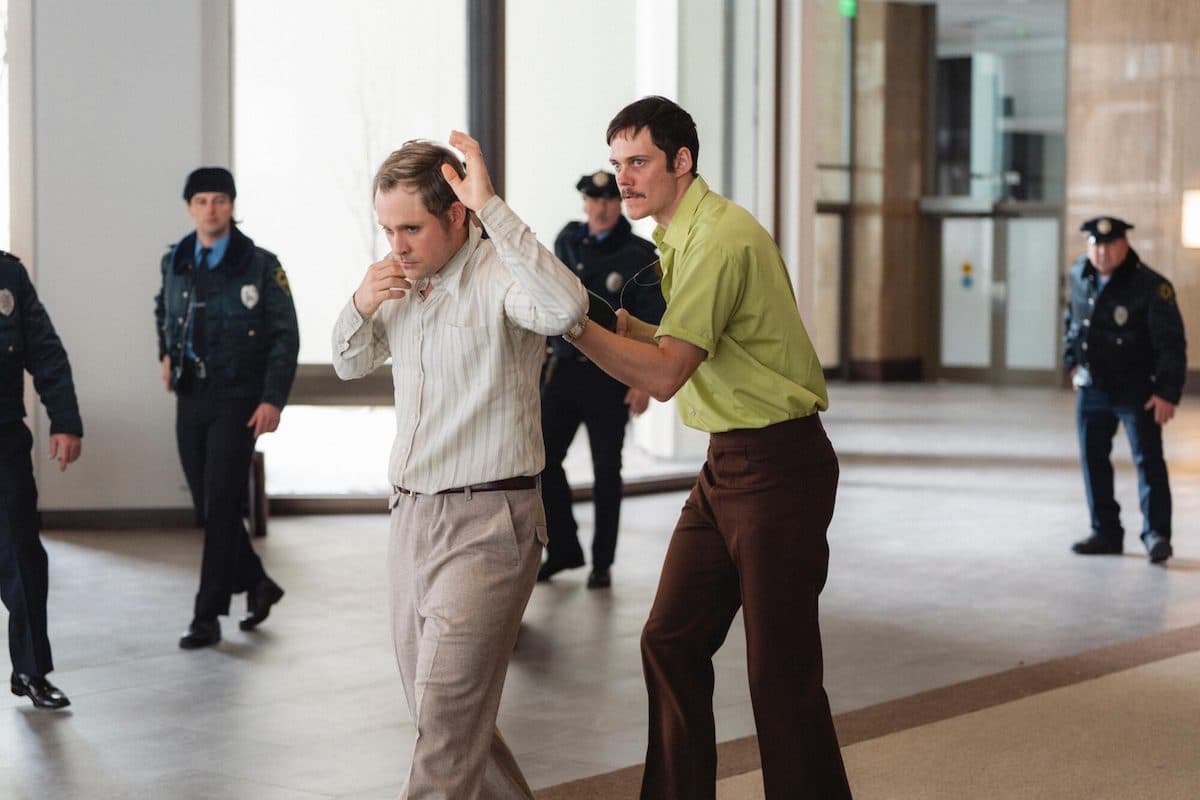
In February 1977, a man named Tony Kiritsis walked into the Indianapolis offices of his mortgage broker and took manager Richard Hall hostage using a “dead man’s line” — a contraption that involved wiring a gun to the neck of his victim and running a line from the trigger to his own finger.
The “fail-deadly” concept meant the mechanism would cause the gun to fire if the captive ran or if Tony was hurt or killed. This fiendish weapon allowed Tony to leave the office building with his hostage without fear of being shot by police and head to his apartment, where a standoff ensued for nearly three days.
The new movie “Dead Man’s Wire” turns the abduction into a tense and satirical look at an odd man seeking approbation and some sort of justice from the public. Directed by acclaimed filmmaker Gus Van Sant, the picture at times resembles “To Die For,” his 1995 black comedy exploring the intersection of media, murder, and American values. Its master template, though, is the 1975 Sidney Lumet-directed classic “Dog Day Afternoon,” particularly considering its unhinged antihero, hostage storyline, and 1970s setting. Even Al Pacino shows up in a few scenes, though this time he portrays someone on “the establishment” side rather than a renegade.
While generally compelling and entertaining, the feature can’t help but feel underwhelming, due in large part to one’s familiarity with the hostage situation/spectacle setup. Its superficial take on media complicity, some muddled details, and the stiff “reenactment” tenor of certain scenes not featuring the main characters also disappoint. Still, the real-life nature of the case, chronicled in a little-seen 2018 documentary, and the steady tension generated throughout keep one interested and even riveted at times.
In the opening scenes, as Tony (Bill Skarsgård) arrives at a brutalist office building carrying a long slim cardboard box, Mr. Van Sant and his cracking creative team make quick work of establishing the offbeat vibe and ’70s look and feel through color, clothing, music, and more. Once inside the mortgage firm’s headquarters, Tony soon attaches the dead man’s wire to Richard Hall (Dacre Montgomery), though his real target is his captive’s father (Mr. Pacino), the company founder who happens to be in Florida.
The movie’s comic tone becomes more apparent as, after alerting the authorities, Tony takes Richard outside so they can drive to his apartment. In a particularly indelible moment, the rigged-together pair slip on ice on the way to the car, eliciting from this viewer a howl of both mirth and terror. (It’s also true to life.)
Once ensconced in his apartment, which is booby-trapped with explosives to ward off snipers and rescuers, Tony makes his demands: He wants his land loan debt to be forgiven, financial compensation, and immunity from prosecution upon the release of his hostage. His most fervent demand, though, is an apology from the brokerage, and specifically Richard’s father, who he claims cheated him out of a deal to sell his land to a commercial developer.
In a key scene, both Richard and Tony speak with the executive over the phone, with Richard pleading with his father to apologize and Tony explaining, when asked by the elder Hall whether he supports anyone, that his business interests are “his kids.” While acknowledging Tony’s entrepreneurial sense and tenacity, the patriarch does not admit to any wrongdoing: “I’m not going to apologize for how interest works.” Needless to say, Mr. Pacino is fantastic in what is essentially a cameo.

After a while, Tony stops communicating with the authorities and instead calls his favorite local DJ, Fred Temple, who airs their conversations. Fred is played by Colman Domingo and the always-welcome actor brings a hip yet wary, elegant energy to the film, contrasting with Mr. Skarsgård’s mercurial, faintly farcical, dynamic performance as Tony. With his “hungry look” and wiry frame, the other famous Stellan Skarsgård son proves an effective stand-in for the real man, even if he’s considerably more handsome and impressive in stature.
Of course Tony’s other foil is Richard, and Mr. Montgomery imparts a sympathetic dignity and reasonableness as the often crouching personage. As the film progresses, the young actor is able to convey Richard’s quietly building anxiety as physical weariness sets in, as Tony’s cause gains public sympathy, and as the forces surrounding the apartment increase.
Despite the tense scenario, scenes pertaining to law enforcement often come off listless and sketchy, with the exception of a scene in which an FBI agent attempts to build a psychological profile of Tony amongst skeptical local authorities. The trajectory of a budding primetime reporter, Linda Page, is barely depicted, leaving actress Myha’la with little to portray. Indeed, when Mr. Van Sant cross-cuts between archival news footage featuring a reporter and simulated news segments featuring Linda, one wonders why he bothered with the character at all beyond the wish for a notable female role.
In real life Tony demanded a press conference in exchange for the release of Richard, and the film recreates this event in all of its potentially disastrous, unbelievable detail, such as how so many figures surround the still shotgun-linked pair. The media event’s seemingly relaxed atmosphere belies the real possibility of violence, yet this strange ambivalence hints at how the whole affair officially ends and what occurs later. Curiously, this compunction extends to the film as well, which, while strong, never zeroes in on the case’s various ethical and social ramifications — or fully captures the self-proclaimed “goddamned national hero” at its center.