
Decline of Print Newspapers, and Broader Plunge in Press Influence, Reflect New Age of ‘Postjournalism’ 

The waning of the 400-year era of newspapers is about cultural changes more momentous than the efficiency and convenience of written words presented digitally.
Elijah Nouvelage/Getty Images
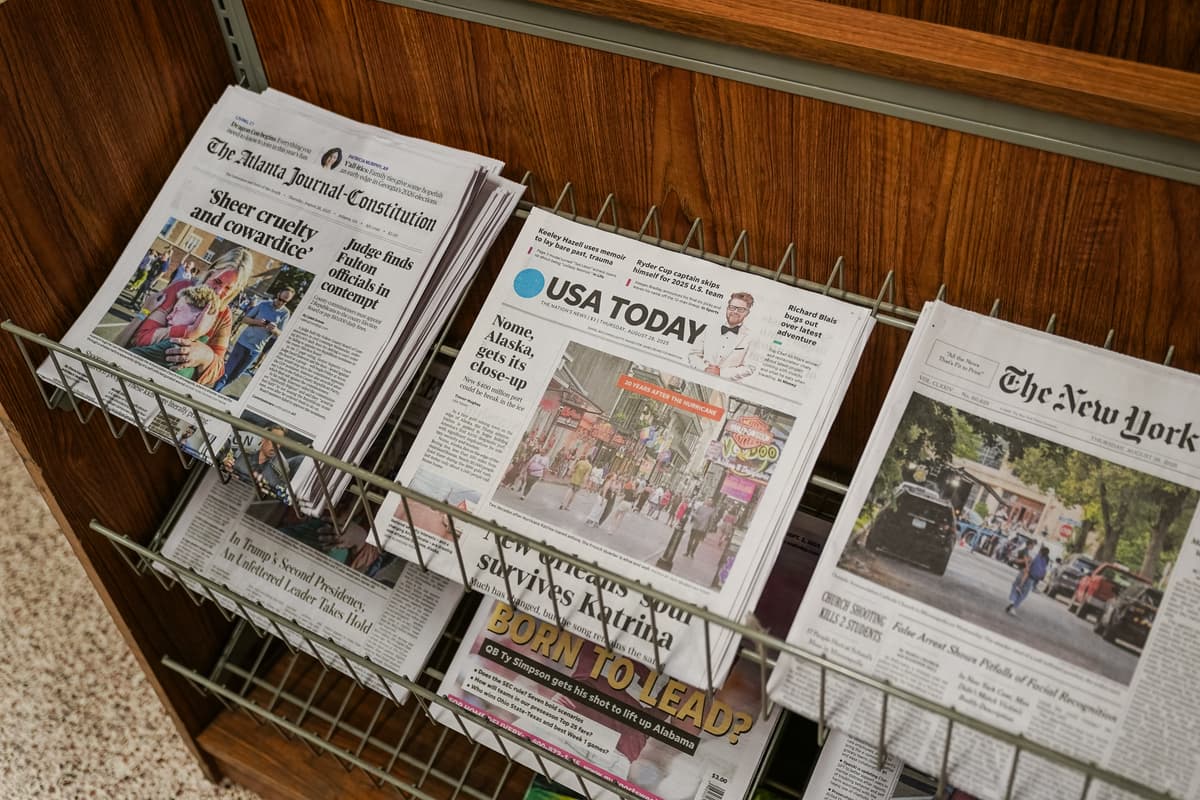
Newspapers, including The Atlanta Journal-Constitution, in a supermarket on August 28, 2025. Elijah Nouvelage/Getty Images

A sound of morning silence is coming to Atlanta. The sound of newspapers landing on sidewalks in residential neighborhoods will vanish when, at year’s end, the Atlanta Journal-Constitution, joining a national trend, stops publishing print editions.

Turning trees into paper, marking it with ink, trucking it to people who deliver it to readers — soon this laboriousness might be as forgotten as men with tongs lugging large slabs of ice for home iceboxes. 

The waning of the 400-year era of newspapers is, however, about cultural changes more momentous than the efficiency and convenience of written words presented digitally.

The Economist reports that the share of American adults who read for pleasure has fallen 40 percent in 20 years, and students’ ability to read in quantity, with comprehension, is in parallel decline. 

An Oxford professor of English says students “struggle to get through one novel in three weeks.” Students lack, another professor says, “habits of application and concentration.”

The sentences that are being read are shorter and simpler. The Economist says an analysis of hundreds of New York Times bestsellers “found that sentences in popular books have contracted by almost a third since the 1930s.” 

Readers, if they can be called such, who are mentally wired for driblets of 280 characters cannot cope with Charles Dickens’s “Bleak House” (1.9 million characters). Can people unable to decipher sophisticated prose manage sophisticated political ideas?

Sophistication, though, is not in the repertoire of journalism devoted to what Andrey Mir, a Canadian, calls the retribalizing of society. In his epigrammatic 2020 book “Postjournalism and the death of newspapers,” Mr. Mir, a self-described “media ecologist,” says the press lost agenda-setting power when the internet enabled crowdsourced agenda-setting.

As advertising dollars migrated to the internet, newspapers, which hitherto were funded from above by selling readers to advertisers, became funded from below by selling themselves to readers. Newspapers encouraged readers to think of subscriptions as donations to political causes. 

Subscribers enjoy their “slactivism,” outsourcing their activism through “donscriptions” — subscriptions thought of as donations.

Mr. Mir says “the last newspaper generation” was born in the early 1980s. It came of age as the internet did. Soon journalism stopped being about informing people to make them citizens, and began to be about making them agitated.

The new business model depends on polarization, amplifying readers’ irritations and frustrations. “A newspaper,” wrote Vladimir Lenin, “is not only a collective propagandist and a collective agitator, but also a collective organiser.”

“Americans,” Mr. Mir says, “consume media 12 hours per day. Counting weekends, this is twice as much as a full-time job.” Because there is insufficient news to fill the time, emphasis has shifted to “expertise, commentaries, and opinions.”

Prestige newspapers’ membership models make them function, Mr. Mir says, as validators. Readers value the newspapers’ attitudes toward events, not the news that readers already know about events. 

Readers must be financially able and emotionally inclined to make “donscriptions.” The work of reader-driven newspapers is to justify the readers’ agenda and inculcate it in others, who will become donors.

What Mr. Mir calls the “commodification of the Trump scare” has completed journalism’s transition from “making happy customers” for department stores and other advertisers, to “making angry citizens.” For what Mr. Mir calls postjournalism, the next challenge is to find a successor scare.

“The shift from rationality to emotionality and peddling intensities” has, Mr. Mir says, made negativity mandatory. Hence this from the Times’s website on May 14, 2020:

“Almost 3 million U.S. workers filed for unemployment last week. Although the weekly tally has been declining since late March, experts are warning of a long struggle ahead.”

There should be a key on the contemporary journalist’s computer that prints the phrase “experts are warning of.” Mr. Mir writes, “The trendsetting emotional tone is easy to read even on the faces of TV hosts”:

“In the 1970s, TV anchors had to wear smiles; now, they are obliged to wear an anxious grimace. Today’s news anchors make a kind of ‘basset face’ that would have looked unprofessional on 1970s TV. In return, an anchor with a ‘corgi face’ from the 1970s would look like an idiot on today’s news show.”

Time flies. Until the 1840s, information could move at about 35 miles per hour — as fast as a train. Today, information matters less relative to opinions, and opinions are distilled to attitudes. 

These are performative, and they compete for attention with upwardly spiraling shrillness. Hence this distinctively 21st-century achievement: the velocity of stupidity.

The Washington Post


The New York Sun

© 2025 The New York Sun Company, LLC. All rights reserved.

Use of this site constitutes acceptance of our Terms of Use and Privacy Policy. The material on this site is protected by copyright law and may not be reproduced, distributed, transmitted, cached or otherwise used.

The New York Sun

Sign in or  create a free account

or
By continuing you agree to our Privacy Policy and Terms of Use