
Exploration of Ellington’s Bond With Africa Provides Highlight of JALCO Season
There was a clear attitude in the atmosphere that this was as good as jazz — and music in general — ever gets.
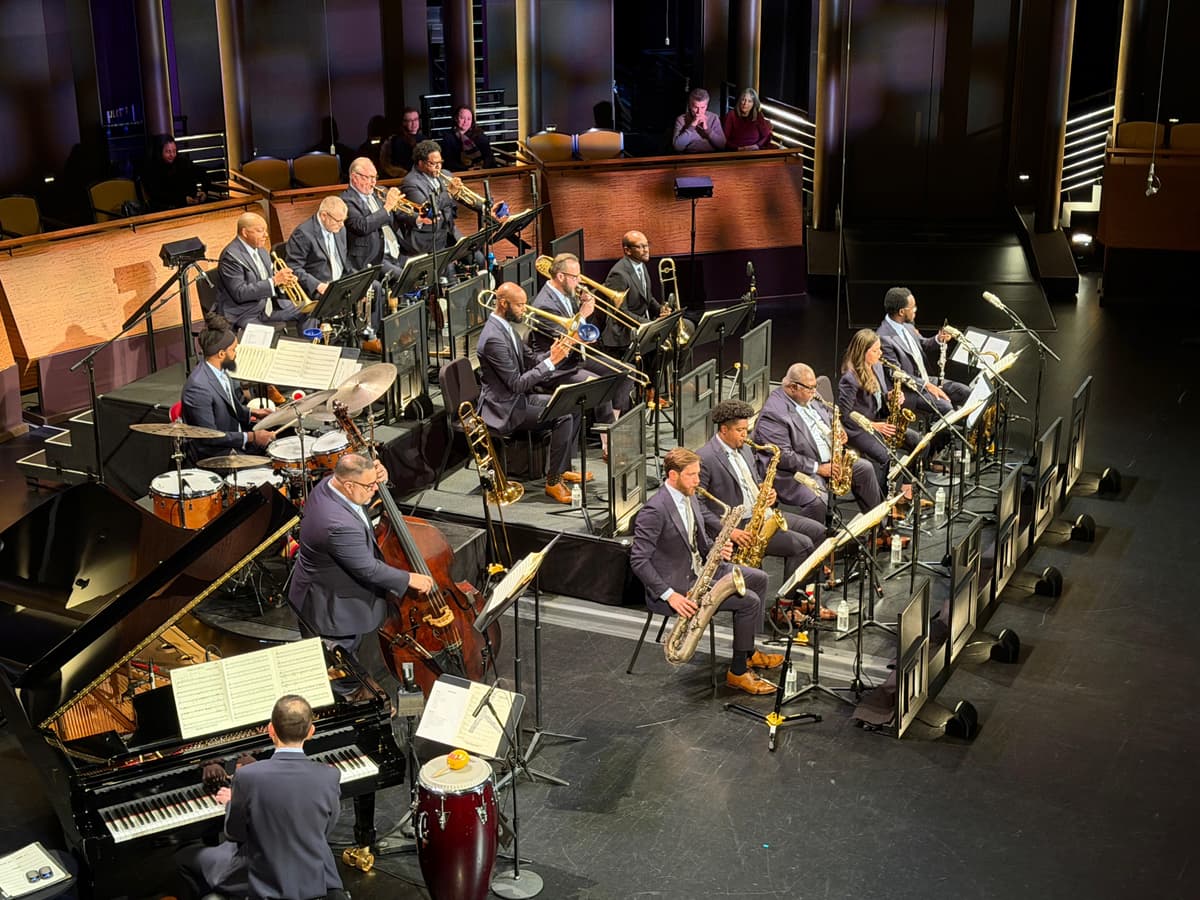
The Jazz at Lincoln Center Orchestra with Wynton Marsalis
Duke In Africa
Through January 17
Streaming Through January 24
In 1966, Duke Ellington visited the continent of Africa for the first time to perform at the First World Festival of Negro Arts at Dakar, Senegal. “After writing African music for 35 years, here I am at last in Africa,” he said.
If anything, Ellington’s fascination with the ideal, if not the reality, of Africa goes back even further to his early Cotton Club days, when he wrote works like “Jungle Blues,” “Jungle Jamboree,” and “Jungle Nights in Harlem” and billed his orchestra on records as “The Jungle Band.”
As Wynton Marsalis and the Jazz at Lincoln Center Orchestra are making clear this weekend, the inspiration of Africa was a persistent, recurring theme throughout Ellington’s entire career. The perfect opportunity for a concert celebrating that inspiration has come during this season that the JALCO is calling “Mother Africa.”
To most of us longtime followers of the organization and the music, the Ellington-Africa connection provided the foundation for the most exciting JALC concert of the season. Almost every year, Mr. Marsalis and the 14 other members of the orchestra try to include a Duke-centric concert in their schedule, to their credit. This was one of the absolute best.

This time, the musical directors were two relatively new members of the reed section, alto saxophonist and flautist Alexa Tarantino, age 33, and tenor saxophonist and clarinetist Chris Lewis, age 28.
Ellington is by far the most-performed of all jazz composers, but nonetheless it’s rare to hear much beyond his hit songs and his most famous longer works: “Such Suite Thunder,” “The Far East Suite” and his adaptation of Tchaikovsky’s “Nutcracker.” By contrast, the JALCO offered a program of music that mostly hasn’t been heard since Duke played it himself, including all four movements of the “Togo Brava Suite,” a work that was famously recorded live in England in 1971, and was transcribed from that album for the JALCO by Mark Lopeman.
The earliest pieces played were from “The Liberian Suite,” a 1947 work written in commemoration of the centennial of the nation of Liberia, and a very early long-playing album. While the suite also contains a song — “I Like the Sunrise,” introduced by the great Al Hibbler — it was a delight to hear two of the instrumental “dances”: “Dance #4” featured drummer Obed Calvaire and the rest of the ensemble essentially playing rings around each other, while “Dance #5” spotlighted Chris Crenshaw playing “ya-ya tromboner,” a highly vocalized sound perfected by Joe “Tricky Sam” Nanton.
Other works derived from the 1963 album “Afro Bossa.” The title suggests a nod to the bossa nova craze that was then becoming an international phenomenon, although the inspiration is more Africa than Brazil. It’s also a collection of works written over many years and involving several different collaborators, such as trombonist Juan Tizol’s 1938 “Pyramid” and Billy Strayhorn’s 1941 “Absinthe.” Yet as a whole it hangs together beautifully.
The JALCO launched the evening with the limber and frisky “Purple Gazelle,” which begins with a playful intro by the piano and rhythm section. Strayhorn’s “Tigress” had pianist Dan Nimmer switching to conga drums behind a powerful tenor saxophone solo by Abdias Armenteros. Nearly every piece featured baritone saxophonist Paul Nedzela standing in the footsteps of the legendary Harry Carney; he must have licked his chops in anticipation of this concert, since no other composer ever gave the bari so much to do.
In 1967, the West African republic of Togo issued a commemorative stamp in honor of Ellington, who repaid the favor with his suite four years later. As originally recorded, “Togo Brava” is only 17 minutes long yet it was a highlight of the show — and the season thus far. This is one of the few Ellington compositions to feature a flute, originally played by Norris Turney in both the Ellington orchestra and much later in the JALCO.
Ms. Tarantino played the primarily solo on “Soul Flute,” acknowledging not only Turney, who later played with an early edition of the JALCO, but her own mentor in the orchestra, Ted Nash.
Both the orchestra and the crowd were in great shape; there was a clear attitude in the atmosphere that this was as good as jazz — and music in general — ever gets. In their hosting duties, which were clearly influenced by Mr. Marsalis, the band’s founder and ongoing artistic director, Ms. Tarantino introduced Ryan Kisor not just as a trumpeter but as a lead trumpeter, and Mr. Lewis repeatedly said “yes indeed” to punctuate the end of a sentence; both of these are iconic Wyntonisms.
The only thing missing from the program was a sample of early Ellington “jungle music,” some of which the JALCO has played on other occasions, and some of which is also heard weekly just a few blocks down from Rose Hall at Birdland, where Vince Giordano and the Nighthawks regularly feature early Ellington. It seems pointless to quibble about what Mr. Marsalis and Co. left out, because what they did play was so satisfying.
Along the way, there were other works, such as “Montage,” a seven-minute condensation of themes from the landmark 1943 “Black, Brown and Beige” — this time incorporating a wordless choir — for Ellington’s 1963 stage show, “My People.”
And there also was “Cottontail,” a 1940 “I Got Rhythm” variation written for tenor saxophonist Ben Webster, here expanded with solos by Mr. Marsalis and trombonist Elliot Mason as well as Mr. Armenteros. The connection to Africa was somewhat tenuous, but it’s a rocking, stomping piece that is also included on the 1972 album “Togo Brava Suite,” and that’s good enough for me.