

Film Forum Revives ‘Sorcerer,’ a Thriller That Is the Equal of ‘The Exorcist’
Friedkin keeps things tense by emphasizing the tenaciousness of his characters and the treachery of their surroundings.
The director William Friedkin (1935-2023) was at the top of his game in the 1970s as both an artistic and commercial force. One would have been hard-pressed to predict that a former mailboy at CBS might scale such heights.
After knocking around as a television documentarian, Friedkin went on to direct an episode of “Alfred Hitchcock Presents”–during which he earned Hitch’s enmity by not wearing a tie on set–and helmed a quartet of films that began with a Sonny and Cher vehicle, “Good Times” (1967), and ended with an adaptation of Mart Crowley’s off-Broadway play, “The Boys in the Band” (1970).
None of which heralded an aesthetic conducive to capturing the hurly-burly of New York City. The brass at 20th-century Fox were leery about putting Friedkin in the director’s chair for its adaptation of Robin Moore’s best-selling book about international drug-trafficking, “The French Connection.” Yet as Friedkin noted later in life, “if there’s one thing I’ve learned over the years, it’s that there is a movie god. Sometimes he’s benevolent, sometimes he’s cruel, but he’s always present.” The movie god smiled: Friedkin got the job.
“The French Connection” proved a formidable box office hit that racked up a slew of Oscars, including Best Picture. For the director’s next venture, the movie god proved benevolent again even though the subject was the antithesis of all that is holy. “The Exorcist” (1973) rattled the cages of the critics, the coffers, and the nation’s conscience with its tale of adolescent bedevilment. Friedkin wanted to follow it up with a picture about extraterrestrial bedevilment, but folded his hand upon learning of Steven Spielberg’s “Close Encounters of the Third Kind” (1977)–or so the scuttlebutt has it.

Instead, he opted for something quixotic: a remake of Henri-Georges Clouzot’s near-masterpiece, “The Wages of Fear” (1953). Bear in mind that Friedkin went to his grave insisting that this wasn’t the case: “Sorcerer” was based directly on the 1950 novel by Georges Arnaud, Le Salaire de la peur. Be that as it may, Friedkin’s “little 2.5 million in-between movie” went on to cost a bundle, ballooning to a budget of $22-million.
The accountants at Universal Studios, keeping an eye on the bottom line, convinced their bosses to partner up with Paramount Studios for what was going to be a huge commercial draw. This was a William Friedkin film, right?
As it turned out, “Sorcerer” flatlined at the box office. The reasons proffered are many, legitimate, and yet unsatisfying all the same. It was released a few weeks after the opening of a relatively unsung film which would change the cultural landscape for decades to come, George Lucas’s “Star Wars” (1977). One of Friedkin’s editors, Bud Smith, told his boss that Mr. Lucas’s space opera “made [‘Sorcerer’] look like this little, amateurish piece of s–t.”
There was the seemingly supernatural title: Were audiences disappointed that “Sorcerer” turned out not to be a follow-up to “The Exorcist?” The preponderance of French, German and Spanish in the early scenes was puzzling, so much so that signage was posted in theaters testifying to “Sorcerer” being an English-language picture. Critics were unkind, offering appraisals that included “insulting,” “dire,” and, memorably, “a pain in the mind.”
Friedkin’s movie is dire, but little and amateurish, it is not. Film Forum is offering a revival of a film that is, in cinematic terms, the equal of “The French Connection,” “The Exorcist,” and “The Wages of Fear.” Like Clouzot’s picture, “Sorcerer” is a film of distinct sections: the first being an extended introduction to a cadre of scurrilous characters on the run, and the second, the lengths that are taken to redeem, if not their souls, then their lives. Who’s to say a film can’t build its logic in parts?
Friedkin’s story includes a low-rent gangster, a disgraced banker, a Palestinian terrorist, and a hitman. There’s also a Nazi on hand and sundry guerilla soldiers doing what they can to defend their own interests at an unnamed country in Central America that is the film’s setting. Their lives in exile are threadbare, so when a chance to earn big money comes along, the men jump on it. Amongst our anti-heroes is Jackie Scanlon, here portrayed by Roy Scheider in all his sinewy redoubt.
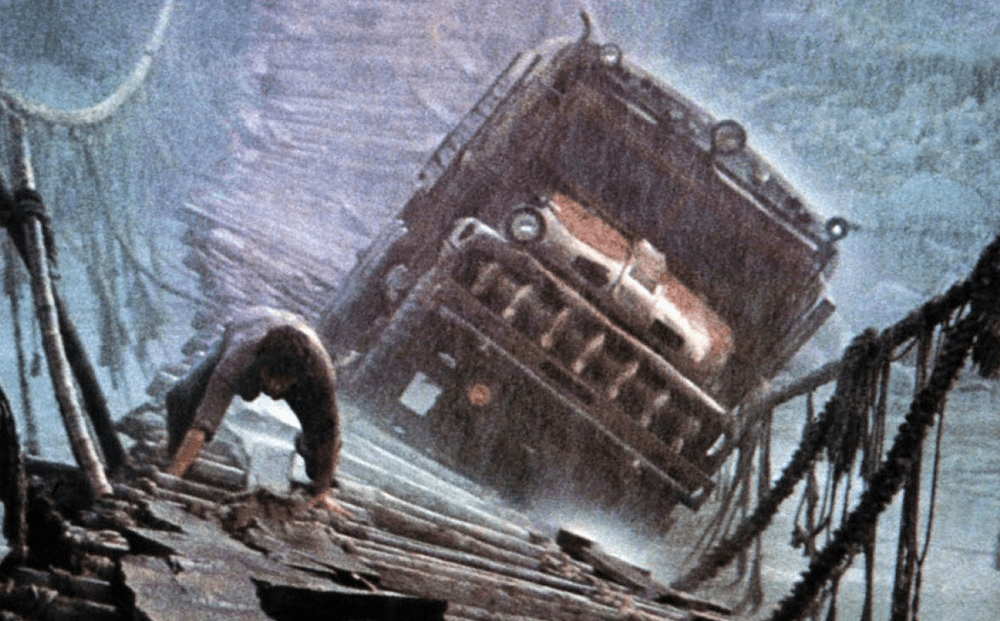
And it is that job–that is to say, transporting highly volatile chemicals over a distance of some 218 treacherous miles–that will keep audiences at the edge of their seats. However implausible the narrative’s circumstances and resolutions, Friedkin keeps things tense by emphasizing the tenaciousness of his characters and the treachery of their surroundings. A scene in which two trucks navigate a wooden bridge is among the most thrilling moments in the history of the artform. Friedkin pulled it off with a mastery that is both terse and operatic.
Friedkin stated that “Sorcerer” was “the film I hope to be remembered by.” Visitors to Film Forum can moot that ambition, but only after they’ve bitten their nails down to the quick.