
Kaleidoscopic Approach to Hemingway Bio Captures Best and Worst of Storied Writer

The virtue of this approach is best seen in its attention to figures you might not expect to encounter in a book about Hemingway.
Via Wikimedia Commons
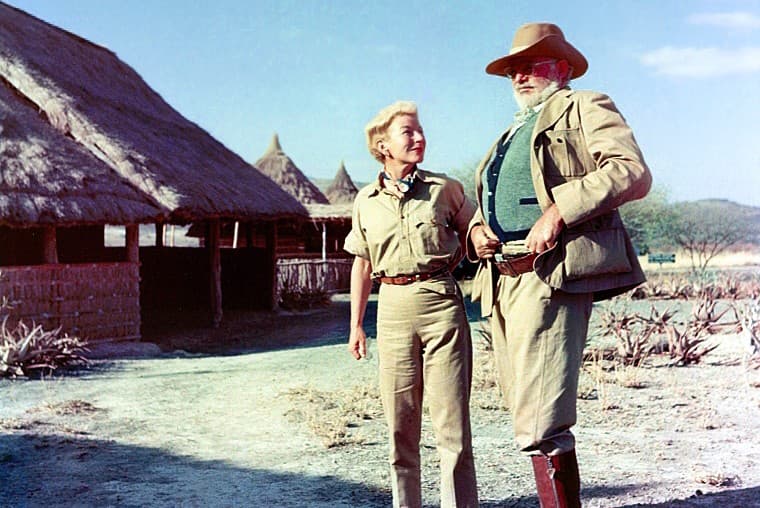
Ernest and Mary Hemingway on safari, 1953-54. Via Wikimedia Commons

‘Forty-Three Ways of Looking at Hemingway’
By Jeffrey Meyers
LSU Press, 344 pages

Jeffrey Meyers, a highly respected biographer of Ernest Hemingway, draws on his decades of engagement with his subject to present a panoply of personages and topics that a single biographical narrative would be hard put to provide.

As you would expect, figures like F. Scott Fitzgerald, all of Hemingway’s wives, his suicide, his achievements and failures, his quarrels, and fascination with war and death are encompassed in Mr. Meyers’s customary brisk and compact prose.

The virtue of his approach is best seen in his attention to figures you might not expect to encounter in a book about Hemingway. For example, Ted Hughes is the subject of a fascinating chapter about Hemingway’s immersion in the world of animals, seeking to understand the creatures of prey that he preys upon, as Hughes does in his poetry. Both men were hunters, killers, who probe what it means to be part of and yet separate from a predatory world.

Mr. Meyers shows how Hemingway castigated AndrĂ© Malraux, a rival writing about war, with an intellectual sensibility alien to Hemingway’s visceral distrust of big ideas. Cezanne, often cited as an influence on Hemingway, is shown to be nothing of the kind — at best a marginal influence that critics have made a fetish of with arguments deemed nugatory. Mr. Meyers is tough on Lillian Ross in her famous profile of Hemingway because she only showed his braggadocio — a genuine but not nearly accurate conception of the whole man.

Chapters ranging from Picasso to Salinger to the gangsters in Hemingway’s fiction, whom Mr. Meyers suggests became the template for Hollywood crime dramas, are bound together in a core of repeated details. Fitzgerald, for example, has a chapter to himself but appears elsewhere as part of Hemingway’s quest to disparage the erstwhile friends who did so much to advance his career.

You might say what whetted Hemingway’s talent also contributed to his decline because of his maniacal, competitive nature, using words as blows, and sometimes blows instead of words when he decked fellow writers like poet Wallace Stevens, who had disparaged him. Such attacks energized Hemingway, but then he became his own victim, perfecting a prose of self-regard that caused him to drop his guard against bloated prose and made him strut around as “Papa Hemingway.”

Conventional biographical narrative, in order to keep the story going, often does not do justice to the minor and secondary figures that are nonetheless essential to understanding a life like Hemingway’s. Mr. Meyers rectifies the problem by introducing several figures — Charles Sweeney, Fridtjof Nansen, Waldo Pierce, Henry Strater, and Alfred Flechtheim — against whom Hemingway measured himself as what you might call a warrior artist.

Mr. Meyers does not try to reconcile Hemingway’s contradictions — such as his praise for military figures like Omar Bradley and Dwight Eisenhower only to later disparage them — except insofar as they become part of Hemingway’s futile quest to assert a superiority of judgment that became ridiculous, culminating in an embarrassing novel, “Across the River and Into the Trees,” in which Colonel Cantwell indulges in dilations about his warrior ethic while romancing a young woman all too supinely there for his delectation.

Mr. Meyers shows that in Hemingway’s best fiction, such as “The Short Happy Life of Francis Macomber,” he was honest and self-critical. In nonfiction, especially “Death in the Afternoon” and “Green Hills of Africa” Hemingway began the process of becoming a parody of himself.

As to Hemingway’s end, Mr. Meyers provides a number of perspectives on the suicide. Some, like William Faulkner, believed Hemingway lost his nerve. Others, like the poet John Berryman (who would later commit suicide) took a much more sympathetic view, believing that suicide could be a courageous act, an honest recognition that the artist and man were played out and he no longer wanted to pretend it was otherwise.

Along the way Mr. Meyers settles a few scores with those who have, for example, alleged that Hemingway could not create believable female characters. But this is not a book that ever minimizes its subject’s faults even as it pays tribute to a writer that at his best ought to be measured, as Hemingway measured himself, against great writers like Leo Tolstoy and Thomas Mann.

Mr. Rollyson is the author of “Amy Lowell Among Her Contemporaries” and “Beautiful Exile: The Life of Martha Gellhorn.”


The New York Sun

© 2026 The New York Sun Company, LLC. All rights reserved.

Use of this site constitutes acceptance of our Terms of Use and Privacy Policy. The material on this site is protected by copyright law and may not be reproduced, distributed, transmitted, cached or otherwise used.

The New York Sun

Sign in or  create a free account

or
By continuing you agree to our Privacy Policy and Terms of Use