

‘Marty Supreme’ Is a Lower East Side Epic, a Table Tennis Triumph, and a Likely Oscar Champion
Timothée Chalamet stars in one of the most electrifying films of the year, its hustle powered by schemes and dreams.
“Marty Supreme,” from director Josh Safdie and A24 studios, has the propulsive energy of a well struck ping pong ball whizzing through the air with millimeters to spare over the net. The movie, starring Timothée Chalamet, Gwyneth Paltrow, and the newly supernova Odessa A’zion, is about table tennis but is much more than a sports movie — it is one of the most electrifying films of the year and another triumph for the irrepressible Mr. Chalamet.
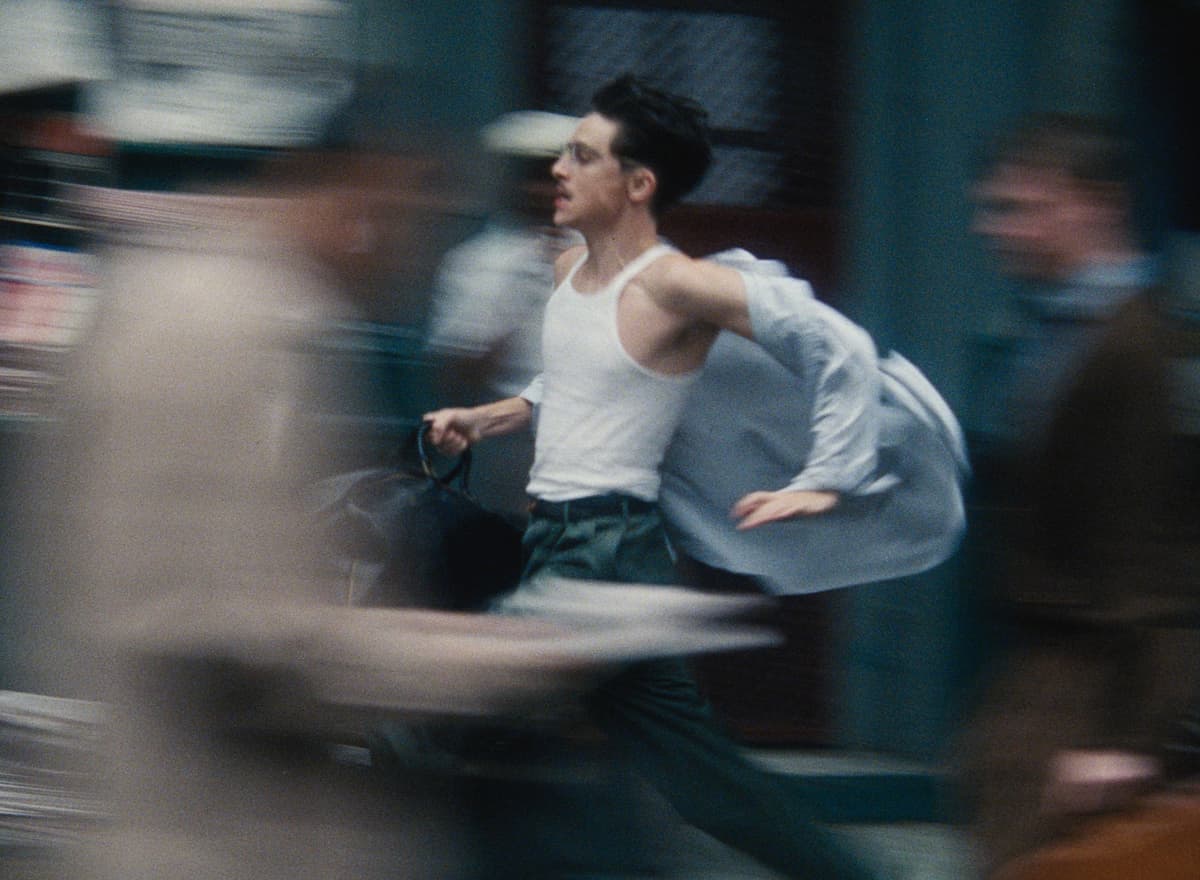
“Marty Supreme” is set at New York City in 1952, Mr. Chalamet’s character — Marty Mauser — is a hustling and twitchy ping-pong shark, a street Jew out to conquer the world with a paddle. He is the endlessly hungry striver of the American mid-century and could be plucked from Mr. Safdie’s “Uncut Gems.” That movie plunged into the Diamond District. This one lovingly resurrects a lost Lower East Side — the twilight of the tenement era.
Marty’s world is marked by violence and love in equal measure. His overbearing uncle wants him to bend himself to his shoe store, where Marty’s charm works to slip bubbies’ feet into flattering sizes. Before long, though, he is shtuping in the backroom with his married girlfriend Rachel Mizler (Ms. A’zion), who works at a pet shop. From then on, Marty is always on the move, his hustle propelled by a mix of schemes and dreams.
Marty, with his star of David necklace dangling over a sweat-drenched white tank top, is not the first Jewish boy to be shaped by the women around him. With his mother, Rebecca (Fran Drescher) he has the kind of suffocating intimacy Philip Roth would immortalize in “Portnoy’s Complaint.” Rachel becomes a partner in crime whose pregnancy is yet another pressure point for Marty as he lusts after ping-pong glory.

“Marty Supreme,” in addition to everything else, is a great sports movie. The matches are riveting, and Mr. Chalemet is just as convincing as a table tennis savant as he was crooning on the harmonica as Bob Dylan in “A Complete Unknown.” The actor reportedly practiced the sport for some seven years to sharpen his technique to the point where he is a credible stand-in for the movie’s real life inspiration, Marty “Needle” Reisman.
The Marty onscreen is fast and feral, and he quickly sets his sights on a wealthy actress and socialite, Kay Stone (a beguiling Gwyneth Paltrow). Marty’s chutzpah proves an aphrodisiac, though the May-December romance is complicated by Kay’s husband (a remarkable Kevin O’Leary), a baron whose wealth tantalizes the penniless Marty, in dire need of funds to finance a flight to Tokyo. There are no free flights, though — a reality Marty learns painfully.
One of the movie’s pleasures are its cameos. In addition to Mr. O’Leary — a Shark Tank veteran — “Marty Supreme” features appearances by David Mamet, Isaac Mizrahi, Pico Iyer, George Gervin, and a bejowled John Catsimatidis as a skeptical investor in Marty’s shtick. The effect is to create a kaleidoscopic New York of people who look like people. The minor characters are as vivid as those imagined by, say, Chaim Grade or Isaac Bashevis Singer.
Marty scores some cash by performing exhibition matches at Harlem Globetrotters games alongside a survivor of Auschwitz — Marty calls himself “Hitler’s worst nightmare.” His most formidable antagonist across the ping pong table, though, is Koto Endo, a Japanese champion who is played by a real life deaf champion from the Land of the Rising Sun, Koto Kawaguchi. Asia’s dominance in table tennis is firmly on the horizon.
Marty is, like Mr. Chalamet’s Dylan, endlessly charismatic but scarcely admirable. Both characters are consumed by their ambition and less conscious of the cost that its pursuit takes on those around them. Marty is always asking for another favor, always casing out the joint for his next mark. His schemes and shell games harken back to a time when living by one’s wits — and in Marty’s case, wrists — meant living by one’s own tenement Torah.
The sheer number of characters that Marty doubletimes on his path to Tokyo testifies to the layers of love within his Lower East Side world. Unlike the cold successes of imagined downtown strivers like Abraham Cahan’s David Levinsky or Budd Schulberg’s Sammy Glick, Marty’s path is never a lonely one — it is crowded and clamoring, a welter of conniving and care. Table tennis might be a minor sport, but it has yielded a major film.