
Not Since Alfred Hitchcock Has Such Tension Erupted in the UN’s Delegates Lounge
The lady with the red fingernails cries out that she’s going to have a heart attack — and then Glory finds Morocco.
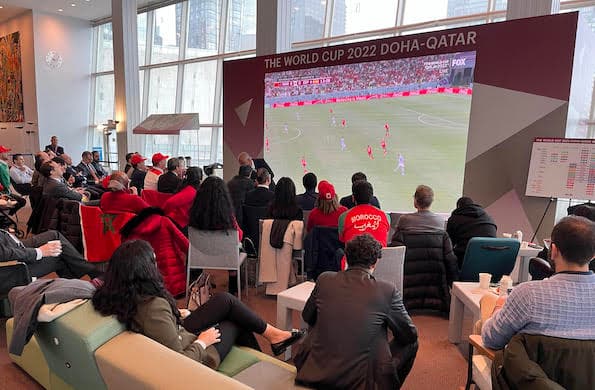
While at Doha both the Spanish and Moroccan World Cup teams were playing poorly Tuesday morning, at the United Nations delegates lounge Morocco was dominant — with diplomats wearing red and green.
On normal days, UN denizens meet for coffee, exchanges of pleasantries, relaxed diplomatic banter, and secret deal making. These days, the lounge is all about the World Cup, and it might be the hottest spot in town.
At the other end of the UN building, the Security Council was debating the humanitarian catastrophe in Ukraine. As is often the case, that formal meeting ended with no discernible outcome. All the energy was at the lounge, taken over this month by the goings-on in Qatar.
This is the room in Alfred Hitchcock’s “North By Northwest” where an ad executive played by Cary Grant, Roger Thornhill, was wrongly accused of knifing a diplomat to death. The UN brass didn’t allow Hitch to film in the real delegates lounge, though; the scene was shot at a Hollywood lot.

Had he been alive, the silver screen’s great story teller would have had fun with this week’s goings on there. No murder was committed Tuesday, but tension was aplenty. To facilitate the proceedings, Qatar donated a high-resolution television screen nearly as large as a soccer penalty box.
At half time, the host was offering free Mideastern-flavored mini sandwiches neatly packed in paper bags. The shawarma, falafel, and halloumi wraps were followed by chocolate chip cookies and cardamom-laced Arabic coffee.
Except for one national red-and-yellow scarf, the few Spanish fans were dressed in discreet gray suits, unlike the much larger pro-Morocco crowd. They had on all forms of the red flag with the green five-corner star. The Moroccans enlivened the room with cheers, claps, and at times screams of joy or fear.
“I’m gonna have a heart attack,” a young UN employee, who had all her nails painted red except for a green-colored index finger, said each time the Moroccan team missed an opportunity to score. Although completely enthralled by her home country’s team, she occasionally joshed with a tall African-European man who was rooting for Spain.
“Nice country, Morocco,” a diplomat who often visits Rabat said in a room where quoting diplomats by name is verboten. “Very pleasant people with quite a moderate political temperament,” he added. “They only go crazy when it comes to Western Sahara.”
The region, known as the Spanish Sahara when Madrid was the colonial power there, is a perennial point of contention between Rabat, Algiers, and an Algeria-backed separatist group known as the Polisario Front.
After the Spanish colonial powers left it in 1975, Western Sahara became the most emotional topic in Morocco. There, any political discussion quickly turns into a heated defense of the kingdom’s sovereignty over the desert tract.
In 2020, President Trump broke a decades’ old diplomatic deadlock when he recognized Morocco’s sovereignty over Western Sahara. In return Rabat joined a group of Arab countries that signed formal peace treaties with Israel. Spain tacitly supports Morocco as well. Yet, at the half time of Tuesday’s game, this reporter walked up to the Moroccan UN ambassador, Omar Hilale, offering a scary scenario.
What if, the reporter said, you lose this game, and Spain immediately moves to take back Western Sahara. Mr. Hilale — a mustache-wearing, smooth, witty veteran diplomat — smiled broadly. “We will win,” he said. “We will definitely win.”
It seemed like a tall order at that time. As the match progressed, Morocco kept missing one goal-scoring opportunity after another. After 90 minutes of regulation and two 15-minutes of extra time sessions, the game was tied at nil. The do-or-die moment arrived. Penalty kicks, a soccer form of a duel at dawn, would end this match once and for all.
At the lounge, nobody could remain seated. The woman with the red and green fingernails was darting to and fro as Morocco scored on one kick. She screamed, fist in air, when Spain then missed. Morocco scored one, and missed another while Spain failed twice to find the net in the soccer equivalent of a football point after.
It was all up to Achraf Hakimi. He was born in Spain, and grew up there. One can almost swim from Spain across the Gibraltar strait to Tangier, one of Morocco’s loveliest cities. Currently playing professionally for the French league’s Qatari-owned Paris Saint-Germain, Mr. Hakimi’s heart has always been with his ancestral homeland.
When his soft-touch goal was finally made, the lounge that has seen so much discreet diplomacy erupted in cheers. Morocco joined Cameroon, Senegal, and Ghana, the only African teams that made it to the world cup’s round of eight. Ambassador Hilale was correct, and one of his country’s former colonizers is out of the tournament.