

Indie Film ‘The Plague’ Locates the Horror in Male Adolescence
First-time feature film director Charlie Polinger was inspired to write the screenplay after reading personal journals from when he was 12 years old at summer camp.
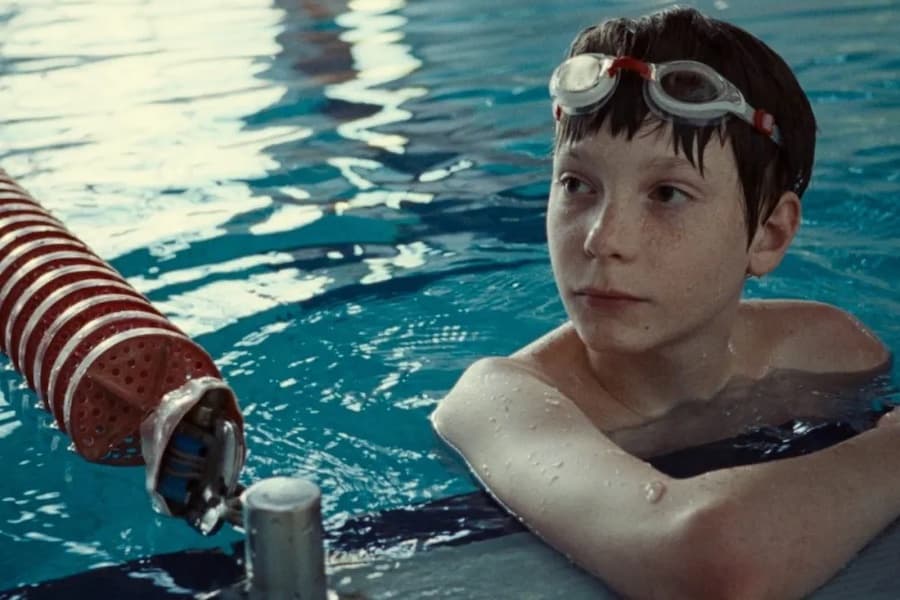
Known for her pastoral, touching coming-of-age novels such as “Anne of Green Gables” and “Emily of New Moon,” the author Lucy Maud Montgomery nonetheless was wise to juvenile brutality: “Children can be the most cruel creatures alive. They have the herd instinct of prejudice against any outsider, and they are merciless in its indulgence.” These lines could very well serve as the logline of the new independent film “The Plague” with its story of a gawky adolescent boy dealing with peer pressure and puberty while at a sports camp.
First-time feature film director Charlie Polinger was inspired to write the screenplay after reading personal journals from when he was 12 years old at summer camp, admitting in press notes that “many of the set pieces, characters, and even dialogue exchanges were lifted directly from them.” This veracity comes through on screen and, combined with impressive performances from its young cast and an atmosphere dripping with psychic isolation and fear, makes for an unsettling yet engrossing viewing experience.
American movies dealing with pubescent boys often take a humorous route, making light of adult themes, social awareness, and body changes. This is markedly different from how female adolescence is portrayed, with the horror movie generally the most popular genre for relaying the physical transformations and private and public ordeals of girls.
One of the reasons “The Plague” feels so fresh is that it approaches male pubescence from this nightmarish perspective. With its litany of pre-teen/teen phobias and anxieties, the film convincingly depicts how increased hormones, masculine norms, and social conformity create a setting ripe with horrific implications, particularly for a sensitive young man.
Said youngster is protagonist Ben, who at the start joins a group of boys learning how to play water polo halfway through one summer in the early aughts. Ben stands out not only because of his newcomer status but for his seriousness when compared with his teammates, who come off as obnoxious and unpleasant.
Almost immediately, he is mocked for his Boston accent and thoughtful demeanor, though they accept him into the group. Not accepted is a character called Eli, who they claim has “the plague” due to his acne, eczema, awkwardness, and nerdy talk.
Anyone who comes in contact with Eli must scrub himself clean immediately, or he, too, will get the so-called plague. Yet Ben, with his irrepressible empathy, is curious about the lonely boy, possibly seeing a part of himself in Eli’s personality. Eventually, the two develop a quiet friendship, bonding over “The Lord of the Rings” and shared sensibilities.
It’s “Lord of the Flies,” though, that is the director’s key reference, as is the work of Stanley Kubrick, evidenced by the film’s oppressive atmosphere and eventual plot once Ben performs an act of kindness for Eli. When the group find out about the deed, the movie dives into Ben’s humiliation and ostracism, insightfully exploring how aggressive bullying and social gaslighting can lead to anxiety and mental deterioration.
Kubrick’s style and thematic proclivities suffuse the film, from the prevalence of eerily balanced architectural shots to the story’s similarity to the first half of “Full Metal Jacket.” Indeed, Eli could be said to be a younger version of that film’s Pyle character, memorably played by Vincent D’Onofrio.
Although a novice actor, Kenny Rasmussen manages to convey Eli’s social isolation and geeky tendencies sympathetically without sacrificing the character’s innate strangeness. The part most like that of the hectoring Sergeant Hartman from the 1987 film belongs to the boys’ leader, Jake, who is also the primary instigator of Ben’s crisis. As portrayed by skateboarder, influencer, and actor Kayo Martin, Jake may look angelic but behind the cherub-like face lies a sadistic, scarily intelligent nature.
As Ben, rising star Everett Blunck could be said to fill the Matthew Modine role in the “Full Metal Jacket” first-half analogy. Similar to his work in “Griffin in Summer,” the actor brilliantly embodies a self-conscious youth, though without that character’s pomposity and with much more discomfort.
Ironies ricochet when one watches Mr. Blunck amongst his fellow young actors: Despite his rangy, slightly effeminate adolescent physicality, the character possesses the bearing of a young adult and budding man while the others look like runts and pipsqueaks despite their macho-aping behavior.
Speaking of adults, the one mature character is Coach Wags, whom Joel Edgerton plays with the right amount of cluelessness and concern. One of the film’s best scenes involves a heart-to-heart talk between Wags and Ben, as the coach attempts to console the boy with positive platitudes and experiential wisdom while the latter expresses subtle impatience, quiet sorrow, and even solicitude towards his instructor.
“The Plague” culminates at an end-of-session dance, à la “Carrie,” though what transpires is both less frantic and more disturbing than that film’s climax. No sorcery or fantastical violence occurs and, while blood is shed, the film remains a relatively realist psychological drama.
From the pranks played and constant sexual chatter to the occasional brutality during sports, Mr. Polinger acutely examines how the process of maturation for boys can be fraught with terrors. Add the dynamics of taunting, exclusion, denial, and shame to the equation and what you might find is not a biological disease but a social one.