

Jordan Harrison’s Prescient Broadway Debut Explores What It Means To Be Human

In ‘Marjorie Prime,’ director Anne Kauffman’s superb cast makes these questions resonate and sting.
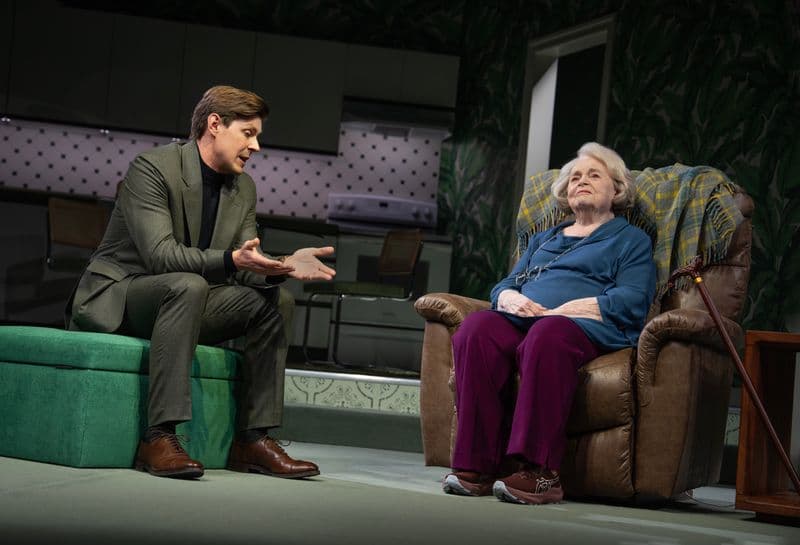
Photo by Joan Marcus
Christopher Lowell and June Squibb in ‘Marjorie Prime.’ Photo by Joan Marcus

Just weeks ago, controversy erupted over a new AI-powered app that reportedly, among other functions, enables users to build interactive avatars of deceased loved ones. “2wai,” as the device is called, is the latest in a growing line of developments in “digital necromancy,” a phenomenon that in earlier stages brought celebrities back from the dead for video and film appearances.

In “Marjorie Prime,” the Pulitzer Prize finalist that marks playwright Jordan Harrison’s Broadway debut, this technology has advanced considerably. Set in the early 2060s — no year is specified outright, but details allow us to do the math — the one-act piece introduces us to an 85-year-old widow suffering from dementia; her caretakers include one Walter Prime, a sort of holographic chatbot designed to look and act exactly like her late husband, Walter, did in his early 30s.

Mr. Harrison’s probing, haunting plays have long examined what it means to be human, and how that can be impacted by external forces. His latest work produced in New York, “The Antiquities,” stretched even further ahead than “Prime” and essentially charted the self-destruction of our race through scientific and entrepreneurial ambition and arrogance.

“Prime” was actually written more than a decade ago; I was able to read the script, which has only been tweaked slightly for this production, before I saw its off-Broadway premiere in 2015. (A screen adaptation was released in 2017.) Even being aware of the twists that inform its plot and enhance its power, I found the play, at that point, as stirring on the stage as I had on the page.

What’s most striking about “Prime” 10 years on is how prophetic Mr. Harrison was, not just in predicting technological advancements but in envisioning how they might affect interpersonal relationships. Much has been reported of late about the growth in AI-generated romantic partners, a trend arguably even more alarming than reaching out to dead relatives because it allows participants to forego the challenges and rewards of connecting — physically, emotionally, and intellectually — with live human beings.

The chatbot-like figures we meet in “Prime” — Walter isn’t the only one — are programmed with memories, many fed to them second-hand, by people who knew the humans they’re simulating. “Do you have emotions … or do you just remember ours?” a human character asks one of them. “Do you feel anything?”

Danny Burstein and Cynthia Nixon in ‘Marjorie Prime.’ Photo by Joan Marcus

Director Anne Kauffman’s superb cast, which includes celebrated stage and screen veterans, makes these questions resonate and sting. When Walter Prime admits, “I sound like whoever I talk to,” Christopher Abbott brings a bright but somehow affectless quality to the line. Walter’s job is to be pleasant and reassuring, and to boost Marjorie’s confidence — not unlike an AI-generated academic coach trying to encourage a struggling student.

June Squibb, a 96-year-old miracle of nature, gives Marjorie an edge of mischief that reminds us the character hasn’t entirely lost her marbles, or her spunk. Walter’s literally artificial, almost patronizing compassion — “I’ll be right here, Marjorie … I have all the time in the world,” he says — can amuse her as much as her middle-aged daughter’s more abrasive solicitousness irritates her.

That daughter, Tess, and her gentler husband, Jon, are juggling the frustrating and saddening process of caring for Marjorie with shepherding their adult children. Cynthia Nixon and Danny Burstein bring predictable wit and empathy to these parts; the performers are especially moving, as is Ms. Squibb, in scenes that emphasize Marjorie’s lingering self-awareness, which can have painful implications for both the elderly woman and those trying to determine how best, and how much, to protect her.

The most chilling scene in “Marjorie Prime” is the final one, in which we witness a three-way conversation that on the surface seems like a study in banal bonhomie, but is in fact something much creepier. Suffice it to say you may leave this gripping production newly grateful for the conflict and candor and ambiguity that help make life and love interesting and authentic, at least for the time being.


The New York Sun

© 2025 The New York Sun Company, LLC. All rights reserved.

Use of this site constitutes acceptance of our Terms of Use and Privacy Policy. The material on this site is protected by copyright law and may not be reproduced, distributed, transmitted, cached or otherwise used.

The New York Sun

Sign in or  create a free account

or
By continuing you agree to our Privacy Policy and Terms of Use