‘The Weight of Injustice Grows Heavier’: Harvey Weinstein Complains to Judge as Plea Negotiations Begin on Rape Charge and Third Trial Looms
A judge set a date for a third trial – on the same rape charge – if Weinstein’s attorneys can’t first reach a plea agreement.
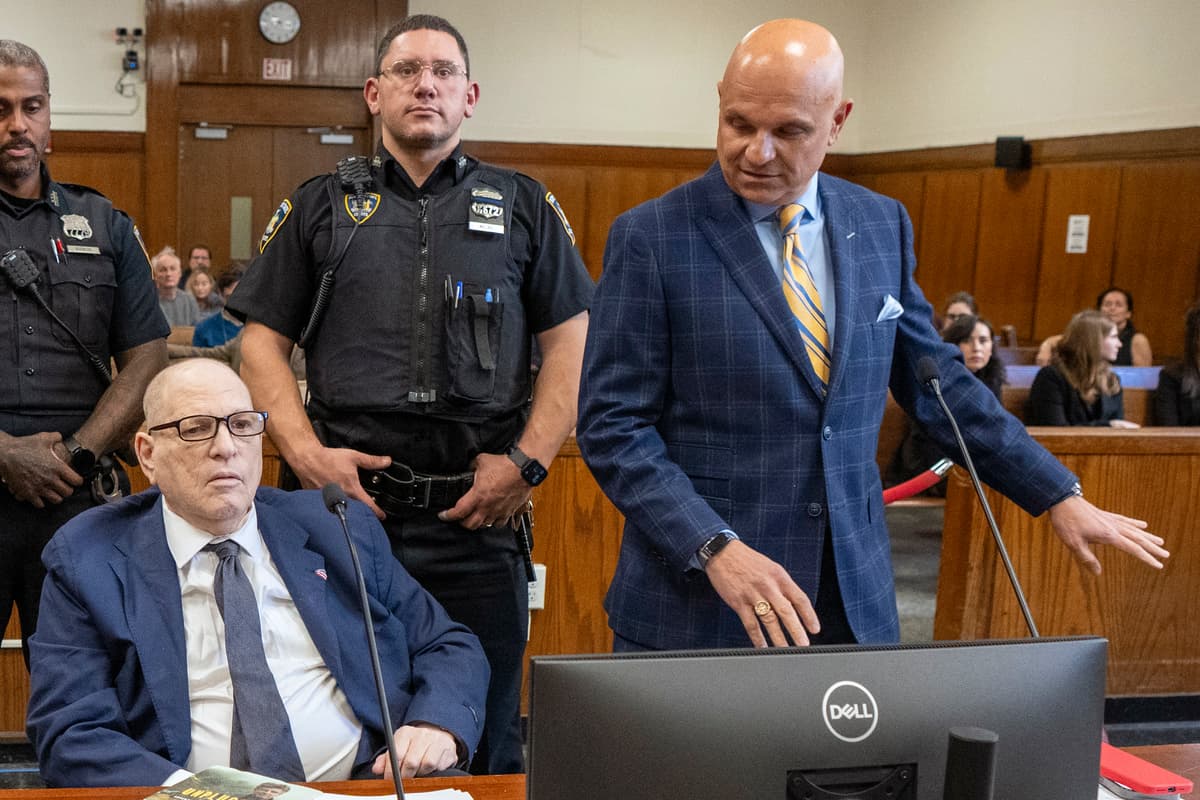

The disgraced movie producer Harvey Weinstein may face a third trial – on the same rape charge – at Manhattan criminal court on March 3, unless he decides to plead guilty to the third-degree rape charge brought by former aspiring actress Jessica Mann.
On Thursday, the presiding judge denied a motion to vacate a separate sexual crime conviction against a different woman, but said he cannot sentence Weinstein until he decides whether or not to plead guilty to the rape charge involving Ms. Mann.
“He never had sexual relations with Jessica Mann that she did not consent to,” lead defense attorney Arthur Aidala told reporters outside the courthouse on Thursday, adding that his client does not want to take responsibility for a crime he claims he did not committ, namely raping Ms. Mann at a Manhattan DoubleTree hotel in 2013. But dealing with a number of health issues, the 73 year-old defendant may not want to undergo the strenuous process of facing another trial.
It would be his third trial at the Manhattan courthouse. In 2020, Weinstein had his first trial, where he was found guilty on the third-rape degree charge brought by Ms. Mann, and a sexual assault charge brought by former production assistant Miriam Haley. The judge sentenced him to 23 years in prison.

Then, in 2024, his defense team scored a historic victory when New York’s Court of Appeals overturned that conviction and ordered a new trial. The court had found that the trial judge wrongly admitted testimony against Weinstein based on vivid allegations from women – including “Sopranos” star Annabella Sciorra who were not part of the indictment. But Weinstein remained incarcerated because he was also convicted in California for sex crimes and sentenced there to 16 years in prison.
His second New York trial took place in the spring of 2025 and lasted about six weeks. The Manhattan jury rendered a split verdict on the three-count indictment brought by the Manhattan District Attorney’s office against the film producer.
Weinstein was convicted on one of the two sex crimes, involving Ms. Haley, who claimed he forcibly performed unwanted oral sex on her at his Manhattan apartment in 2006. He was acquitted of the second sex crime, regarding a former Polish model, Kaja Sokola, who alleged that the producer also forcibly performed oral sex on her at a Manhattan hotel room the same year.
The accusation of third-degree rape remained unresolved. The judge declared a mistrial after the jury’s foreman declined to return to the deliberation room, stating on the record that deliberations had become intolerable for him.
Prosecutors want to try the count again, even though it only carries a maximum sentence of four years, which he would have already served, since he has been incarcerated since 2020.

“Why can’t we land the plane?” Mr. Aidala told the judge in the courtroom on Thursday, expressing his frustration. “We’re gonna go to trial for a third time on a E – as an elephant – felony?” An E felony in New York is the least severe felony.
“He’s got 16 years in California.” Mr. Aidala went on. “He’s got tremendous health problems…” The attorney also argued that the key witness, the alleged victim, Ms. Mann was “diminishing her own mental health” by testifying. He asked why she would want to “come here and do it again?… She went to hospital at the first trial… They had to fly her mother in.”
Mr. Aidala reasoned that his client’s celebrity status may be the reason why the case was being given so much attention.
“If his name was not Harvey Weinstein, we would figure out a way to resolve this case… If his name was Harvey Jones… the DA’s office would say… ‘We’re not gonna waste the tax payers money… It’s a waste of time, effort, finances…”
But an assistant district attorney, Nicole Blumberg vehemently disagreed with the defense and said it was “the people’s position that this is not a waste of money,” and not because Weinstein was an Oscar-winning film producer, “not because of what his name” but because of what “justice is.”
“Does he have interest in pleading on the count?” The presiding judge, Curtis Faber, asked the defense attorney.
Mr. Aidala then accompanied his client, who is wheelchair bound, to the holding cell next to the courtroom. After a short break, the defense attorney and the defendant returned.
“I did have a chance to speak to Mr. Weinstein and I would like to pursue plea negotiations.” Mr. Aidala told the judge. The attorneys from both sides went to a back room with the judge, and continued discussions there. But could not reach a final decision.

Judge Faber said he would keep the date of March 3 on the calendar for now. Then Weinstein asked the judge for “60 seconds” to address the court, which he was granted.
Earlier, Judge Faber had denied the defense’s motion to vacate the conviction on the Miriam Haley count.
“The motion is denied in its entirety,” the judge ruled and said that he had prepared a written decision. The defense attorneys had filed a motion based on two affidavits from two separate jurors, arguing that Weinstein’s guilty verdict should be vacated because it was reached “under duress,” as Mr. Aidala phrased it.
In sworn statements, two jurors testified that they felt they had been pressured into finding the defendant guilty by other jurors, who threatened their safety.
“The affidavits defendant submitted from Juror 7 and Juror 6 neither changes this Court’s assessment that it responded appropriately to juror complaints during the course of deliberations, nor provides any further grounds in support of defendant’s motion to set aside the verdict,” the judge wrote in his decision, which was published on Thursday. “As defendant concedes, a jury verdict may ‘not be impeached by proof of the tenor of its deliberations.’”
Then Weinstein spoke, remaining seated in his wheelchair, presumably due to his infirmities. “I am disappointed in today’s decision,” he Weinstein, partially reading from a prepared statement and partially extemporizing. “They stripped me of my most basic right to be judged fairly.”
The film producer reiterated what his attorneys had argued, that he felt he had been denied a fair trial due to the juror misconduct that “turned this process into something that feels predetermined, not just flawed.”

“At least one juror carried a personal agenda, intimidating others and spreading false allegations that I bribed someone who believed in my innocence. These actions shattered any hope of impartiality. This is the second time I have endured this ordeal, and each time, the weight of injustice grows heavier,” a ghostly pale and drawn Weinstein went on.
“My mental state has collapsed under this burden. I live in constant anxiety,” he said in a scratchy, weak voice. “I feel hopeless, powerless, and forgotten.”
He said being incarcerated at New York’s notorious Rikers Island jail equals a “death sentence” and asked the judge to reconsider his decision.
“Thank you Mr. Weinstein,” Judge Faber told the defendant. “I hope your counsel will give you a copy of my 25 page decision… I promise you that you had a fair trial.”
The judge encouraged Weinstein to read his decision and explained again that jury deliberations can become “heated” and that sometimes jurors “don’t behave in a manner that we would hope.”
The judge set a pre-trial motion schedule for the attorneys. He said he could not sentence Weinstein on the conviction until he “had all the information,” meaning he knew if Weinstein would plead guilty or not.
Outside the courthouse, the defense attorneys spoke to the media but did not give any insight into whether or not their client would take the plea or head into a third trial.