Bill Gates’s Rethinking on Global Warming Is a Rebuke of Climate Hysteria — and a Gift to the World

It is neither prudent nor decent to sacrifice the vulnerable on altars erected by the comfortable.
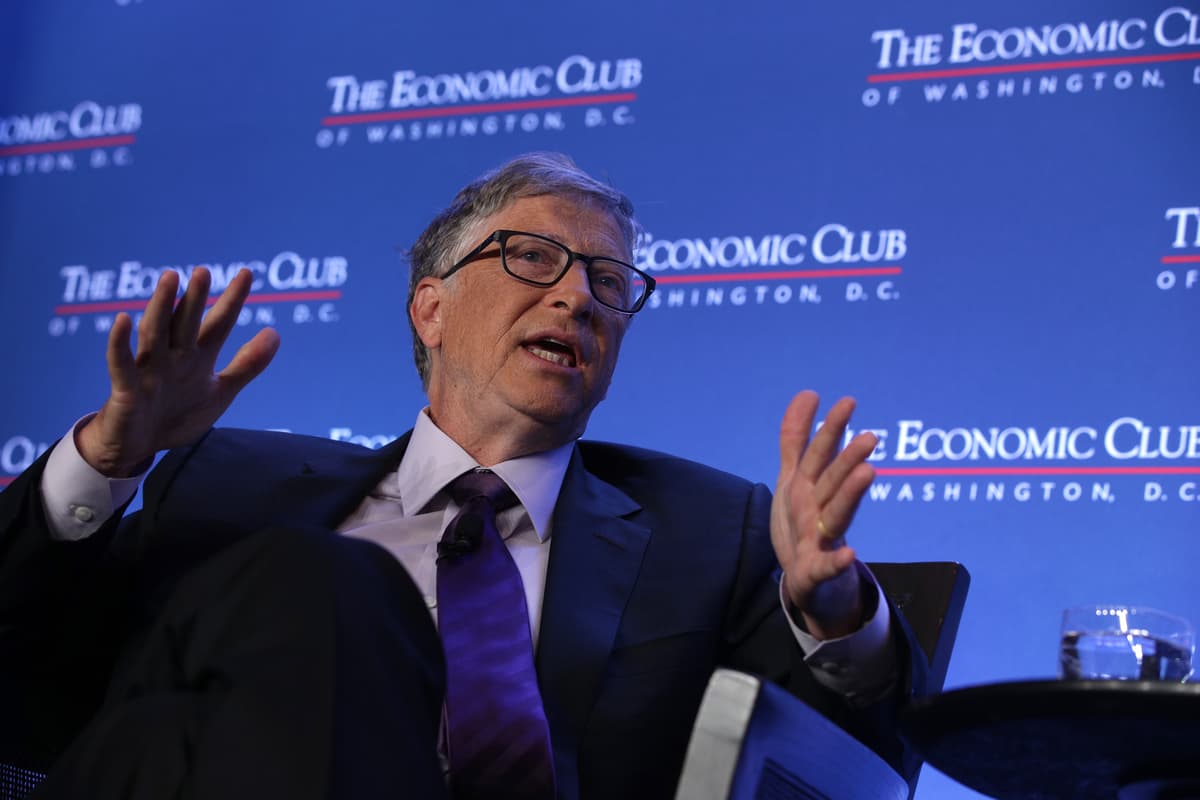
Alex Wong/Getty Images
Bill Gates at the Economic Club of Washington on June 24, 2019. Alex Wong/Getty Images

Bill Gates has had second thoughts. This has provoked scorn from those whose first and only thoughts about his subject — climate change — are secondhand thoughts, acquired by the assimilation of manufactured opinion.

In a long online post, Mr. Gates advocates reconsidering the relative importance of climate change — relative to other potential investments of society’s finite resources of time, attention and money. Relative, especially, to what we know how to do, which is to manufacture and distribute effective vaccines.

Mr. Gates’s argument would be valid even absent what has partially provoked him to make it: the Trump administration’s cuts to humanitarian foreign aid, especially combating communicable diseases, and the appointment of an anti-vaccine crank as secretary of health and human services.

To be sure, greenhouse gases generated by the activities of more than 8 billion people are changing Earth’s climate. How much, how fast, for how long, and with what consequences (some of them, such as more greenery, beneficial) are unknowable. Climate models are of limited use, so prudence is wise.

It is, however, neither prudent nor decent to sacrifice the vulnerable on altars erected by the comfortable. Mr. Gates cites (without naming) a low-income country whose government, clambering aboard the cut-emissions bandwagon driven by developed nations, banned synthetic fertilizers. 

Mr. Gates: “Farmers’ yields plummeted, there was much less food available, and prices skyrocketed.” Progress in every sphere depends on improved health and steady economic growth. Every society that produces social surpluses for investments is dependent on fossil fuels, for which there is no near-term substitute.

Because Mr. Gates participated prominently in the overwrought reaction to the fact that humanity has an impact on its habitat, his reconsideration is especially admirable. “A foolish consistency is the hobgoblin of little minds,” said Ralph Waldo Emerson. Mr. Gates’s big mind accommodates discomfiting evidence.

He has given us a gift of something rare in an age of ideologically intoxicated intellectuals: an example of intellectual responsibility. 

He might nudge the climate debate from posturing about fanciful goals (e.g., “net zero” greenhouse gas emissions), away from which developed nations are slinking, and toward a utilitarian calculus: the greatest happiness for the greatest number.

If so, Mr. Gates will have helped save millions of actual lives, disproportionately young, rather than the hypothetical billions supposedly imperiled by a global warming by 2-degrees or 3-degrees Celsius (from the preindustrial level) by 2100. 

Such warming might mean a 2 percent reduction in what otherwise would be the global GDP in 2100. That loss of wealth creation is not trivial, but neither is it a remotely “existential” threat to humanity.

Thoughtful people can disagree about what is the second-most important development in history for reducing the quantity of human suffering. 

A strong candidate for that title is the conquest of smallpox by 1980. Much the most important, however, has been globalization — the liberalized movement of goods, services and knowledge since the mid-20th century.

Free trade has made normal something essentially unknown in the human story before the late 18th century: economic growth. This has been turbocharged by free trade since World War II. In 1950, almost 60 percent of the world’s population lived in what the World Bank terms “extreme poverty,” on $2.15 per day. Today, 8.5 percent do.

Someday, calm histories will be written about the climate hysteria of 1990-2025. Some might compare it to the madness of crowds, akin to the Dutch tulip mania of 1637, when prices for some rare bulbs briefly reached six times the average Dutch annual income before the bubble burst. 

Yet climate hysteria has been confined to elites; the general public never considered climate change a reason for enormous expenditures or even inconvenient behavior changes. So, historians will dwell upon several sociologies.

The sociology of the intellectual class: Many intellectuals, feeling undeservedly uninfluential, grasp for attention as prophets of apocalypses. The sociology of government: It prefers funding research of “existential” urgency, which bolsters the prestige of government’s grant-dispensers. 

The sociology of science: Scientists’ lucrative careers and tenure-track university positions are elusive for skeptics about a government-subsidized, semi-enforced “consensus.” 

The sociology of academia: Eager to be society’s conscience and Cassandras, humanities professors can continue interpreting Proust to a few undergraduates but start interpreting climate change to millions as comeuppance for bourgeois acquisitiveness. 

The sociology of K-12 education: Teaching multiplication tables to third graders is necessary; terrifying them about a fatal future is public-spirited. 

The sociology of journalism: Reporting on doomsday approaching because the masses are irresponsible is a career path paved with prizes.

The climate-change-resistance industry grew as Mr. Gates’s industry was giving us a digital future. His will wax as the other wanes.

The Washington Post


The New York Sun

© 2025 The New York Sun Company, LLC. All rights reserved.

Use of this site constitutes acceptance of our Terms of Use and Privacy Policy. The material on this site is protected by copyright law and may not be reproduced, distributed, transmitted, cached or otherwise used.

The New York Sun

Sign in or  create a free account

or
By continuing you agree to our Privacy Policy and Terms of Use