
If Republicans Nominate Ken Paxton in 2026, Texas Could Send Its First Democrat to Senate in 40 Years
That prospect, though, depends on prudence conquering the national Democratic Party’s impulse to incessantly annoy the electorate’s temperate center.
Democrats last carried Texas in a presidential election 49 years ago, last elected a United States senator there in 1986, and have lost all statewide elections since 1994. Texas Republicans could, however, surrender their considerable advantages and lose the state’s 2026 Senate election.
Senator Cornyn, who next year will seek a fifth term, is respected by colleagues, who elected him to be Republican whip between 2013 and 2019. He is judicious: He was a Texas supreme court justice. He is conservative: The National Rifle Association and the National Federation of Independent Businesses give him 100 percent ratings. His AFL-CIO rating is zero percent.
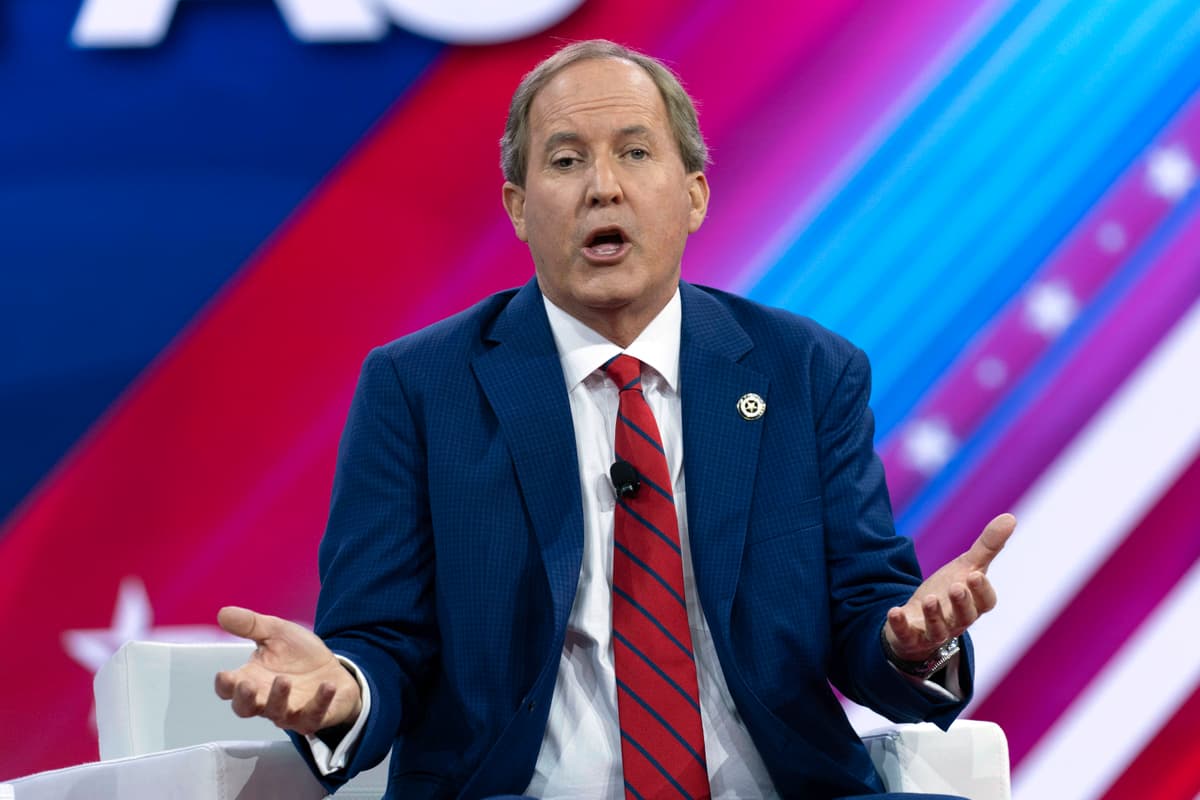
Currently, however, Mr. Cornyn is polling behind a challenger in next year’s Republican primary: Attorney General Ken Paxton, who has, to say no more, a checkered past.
Resignations and whistleblowers from Mr. Paxton’s office, and his, shall we say, casual approach to financial disclosures and appearances, have occasioned doubts about his administrative competence and the rigor of his ethical scruples.
There also are interesting questions about how he, without private wealth and having been in elective offices most of his adult life, has come to own properties in Texas, Utah, Hawaii, Oklahoma, and Florida.
Where there is smoke there is not necessarily fire, but Mr. Paxton’s public career and private financial and personal affairs have generated enough smoke to cover Texas across the 800 miles at its widest points. Furthermore, Mr. Paxton is markedly discordant with today’s Texas.
The state is a far cry from longhorns roaming wide-open spaces dotted with oil derricks. It has six of the nation’s 25 most-populous cities: Houston (4), San Antonio (7), Dallas (9), Austin (10), Fort Worth (13), and El Paso (22).
Texas has the headquarters of 107 of the Fortune 1,000 companies, including many non-energy corporations: e.g., AT&T, Tesla, Dell Technologies, Hewlett-Packard, Charles Schwab, and American and Southwest airlines.
Texas’s oil industry has been gigantic since January 1901, when astonished drillers on a hillock called Spindletop, near Beaumont, brought on an uncontrollable geyser.
In “Texas: An American History” (Yale, 2025), a Southern Methodist University historian, Benjamin H. Johnson, writes that oil coated “all of Beaumont’s buildings” before “it settled down to a steady production of 100,000 barrels a day, a thousand times greater than what had been considered a good well.”
In 1931, the Texas National Guard was deployed to East Texas to combat an oil crisis: A glut was depressing prices. By 1928, Texas produced one-fifth of the world’s oil. By 1950, oil had been produced in 80 percent of the state’s 254 counties.
Today, however, Texas is unlike the cattle- and oil-centered state depicted in the 1956 movie “Giant.” It is remarkably urbanized, economically complex, and culturally sophisticated. Mr. Paxton is (to be polite rather than — heaven forbid — judgmental) a colorful reminder of Texas’s pre-modern past.
As in 1938, when W. Lee “Pappy” O’Daniel toured with his company-sponsored country musicians, the Light Crust Doughboys, to get elected governor. Three years later, this entertainer-as-politician won a Senate seat by winning a special election against Representative Lyndon Johnson.
In 2024, President Trump carried Texas by 13 points. That was, however, less than his margin in 19 of the 31 states he won. Someday, Texas will elect another Democratic senator.
Were Mr. Trump to endorse Mr. Paxton, whose enthusiasm for Mr. Trump has been reciprocated, that day could come two Novembers from now.
This assumes what cannot be assumed: that prudence will conquer the national Democratic Party’s impulse to incessantly annoy the electorate’s temperate center.
Mr. Cornyn has hired a Trump political adviser, Chris LaCivita, to run a super PAC supporting his re-election. And Mr. Cornyn has hired Mr. Trump’s pollster, Tony Fabrizio.
If Mr. Cornyn is renominated, his re-election would be highly probable, so securing it would not burden the national party. With Mr. Paxton as its nominee, the Republican Party might have to spend $250 million (Texas’s 20 broadcast media markets devour $2 million a week for saturation advertising) to drag him to victory. Even that sum might fail to do so.
Also, every national dollar spent in Texas cannot be spent elsewhere. So, if Texas’s Republicans pick Mr. Paxton in the March 3 primary next year, this would improve Democrats’ now-slim hopes for capturing the Senate.
Another dimension to the Cornyn-Paxton contest is aesthetic but has civic importance. Plainly put, Mr. Cornyn is a gentleman. This might seem like an eccentric, because anachronistic, consideration.
It has, however, contemporary relevance: Any subtraction from the Republican Party’s supply of civility increases the party’s already large quotient of loutishness.
The Washington Post