

Judge Blocks ‘Nonsensical’ Mamdani Pied-à-Terre Rollout for ‘Doxxing’ New Yorkers, Tells Mayor To Start Over
By JENNIFER DOHERTY
|A.E. Housman’s ‘Epitaph’ measures the ironic distance between the heroic language of grand myth and the flatness of commercial monetary terms, turning that verbal irony itself into the stuff of tragedy and cosmic purpose.

Published:
Updated:
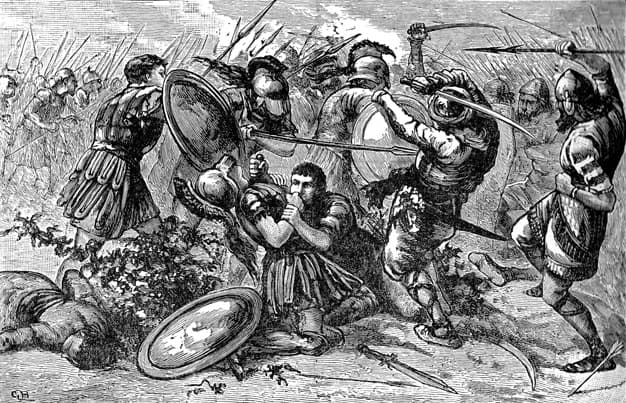
Part of the reason A.E. Housman (1859–1936) holds a high and immovable place for those who read and write formal poetry is that — as the Sun pointed out in March, when the Poem of the Day column featured Housman’s sardonic “When I Was One-and-Twenty” — the British poet had a facility for making formal verse look easy. And as every writer knows, simple is hard. Maybe the hardest of all things to do. Everyone is forced to recognize Housman as a great craftsman. In “Epitaph on an Army of Mercenaries” (1917), a pair of tetrameter quatrains, rhymed abab, measure the ironic distance between the heroic language of grand myth and the flatness of commercial monetary terms: such lines as “Their shoulders held the sky suspended” ironically set against such lines as “And took their wages and are dead.” In just eight lines, however, Housman turns that verbal irony itself into the stuff of tragedy and cosmic purpose: “What God abandoned, these defended, / And saved the sum of things for pay.”
By JENNIFER DOHERTY
|
By LAWRENCE KUDLOW
|
By ALEX ZDAN
|
By BRADLEY CORTRIGHT
|
By THE NEW YORK SUN
|
By JENNIFER DOHERTY
|
By SHAILI SINGH
|
By BENNY AVNI
|Part of the reason A.E. Housman (1859–1936) holds a high and immovable place for those who read and write formal poetry is that — as the Sun pointed out in March, when the Poem of the Day column featured Housman’s sardonic “When I Was One-and-Twenty” — the British poet had a facility for making formal verse look easy. And as every writer knows, simple is hard. Maybe the hardest of all things to do. Everyone is forced to recognize Housman as a great craftsman. In “Epitaph on an Army of Mercenaries” (1917), a pair of tetrameter quatrains, rhymed abab, measure the ironic distance between the heroic language of grand myth and the flatness of commercial monetary terms: such lines as “Their shoulders held the sky suspended” ironically set against such lines as “And took their wages and are dead.” In just eight lines, however, Housman turns that verbal irony itself into the stuff of tragedy and cosmic purpose: “What God abandoned, these defended, / And saved the sum of things for pay.”
Already have a subscription? Sign in to continue reading
Cancel anytime
By continuing you agree to our Privacy Policy and Terms of Service.
Cancel anytime