


Supreme Court Appears Skeptical of Efforts To Overturn States’ Transgender Sports Bans

The outcome of the cases is likely to affect 25 other states with similar bans.
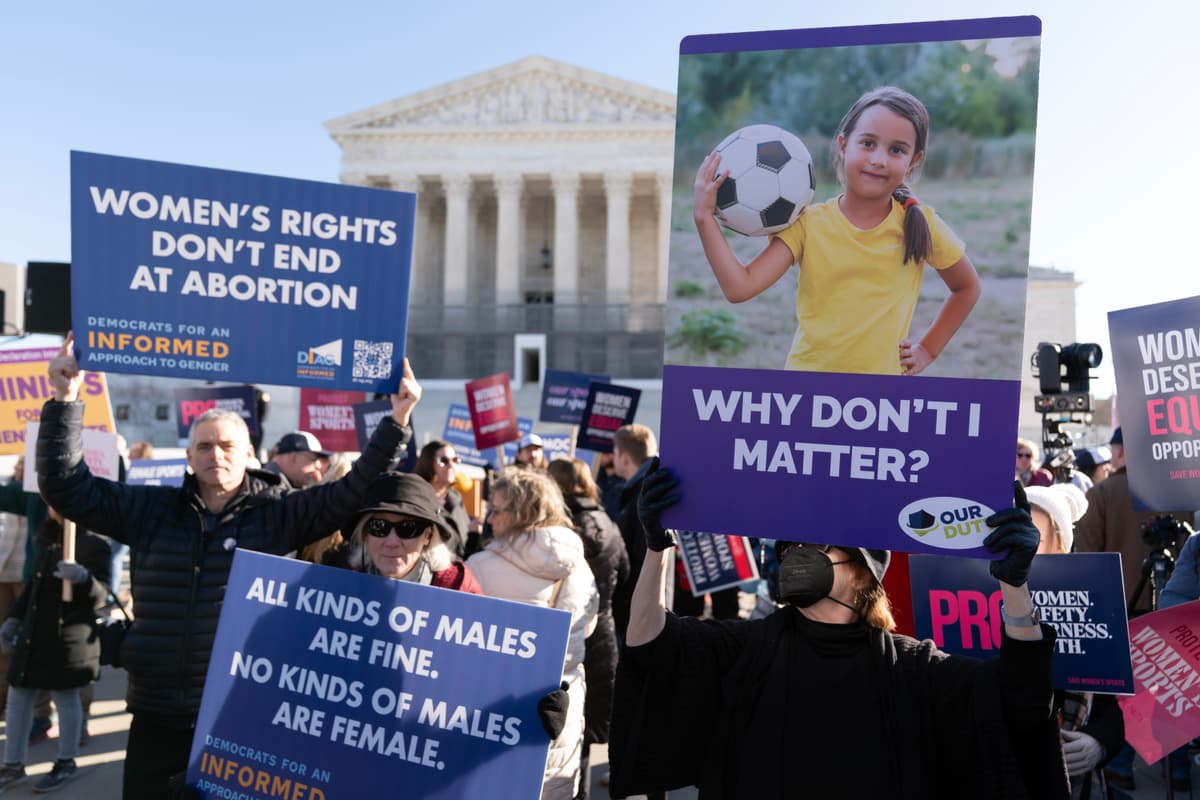
AP/Jose Luis Magana
Protesters outside the Supreme Court as it hears arguments over state laws barring transgender athletes from girls' sports. AP/Jose Luis Magana

The conservative majority of the Supreme Court seems skeptical of arguments seeking to overturn two state laws that ban biological males from competing in female sports.

The court heard more than three hours of arguments Tuesday in connection with cases from Idaho and West Virginia involving restrictions on transgender athletes’ participation in school sports. The decisions could affect similar bans in 25 other states.

The justices first heard the Idaho case first involving Lindsay Hecox, who went through puberty before transitioning. The plaintiff has decided to refrain from further efforts to participate in collegiate sports and moved to withdraw from the suit in September, and some justices asked if that made the case moot.

The solicitor general of Idaho, Alan Hurst, defended the transgender ban and told the justices the case was not moot. In his argument, Mr. Hurst acknowledged that there has been discrimination against transgender people but claimed it doesn’t compare to discrimination blacks and women have faced in the past in America.

After more than an hour of questioning, the justices turned to the plaintiff’s attorney, Kathleen Hartnett, who refused to define boy or girl or man or woman when asked to do so by Justice Samual Alito.

“We do not have a definition for the court,” Ms. Hartnett said.

“How can a court determine whether there is discrimination on the basis of sex without knowing what sex means for equal protection purposes?” Justice Alito then asked.

“I think here we just know — we basically know that they’ve identified, pursuant to their own statute, Lindsay qualifies as birth-sex male and she’s being excluded categorically from the women’s teams,” Ms. Hartnett said.

Ms. Hartnett tried to narrow the focus on the case. She conceded that states could have bans on biological males competing in female sports but there should be an exemption for a small subset of biological males who had transitioned before puberty and do not have the physical advantages of a male with elevated testosterone levels characteristic of post-puberty.

“So you are saying that the school can discriminate on the basis of transgender status?” Justice Alito then asked.

“That might get heightened scrutiny, and heightened scrutiny might be satisfied,” Ms. Hartnett answered.

“Do you want a biological exception for the biological definition of girls?” Chief Justice John Roberts asked.

“We’re not asking for a particular definition or really an exception,” Ms. Hartnett answered.

Justice Kavanaugh called the growth of girls’ sports over the last 50 years “inspiring” and noted that the NCAA and other groups have stated that allowing transgender athletes to participate will “undermine or reverse that amazing success.”

During his rebuttal, Mr. Hurst called transgender competitors a “real threat” to women’s sports, noting that hundreds of biological females have lost to biological males. He also argued that medical transition does not reliably eliminate all advantages for a transgender athlete.

“Bottom line, sports are assigned by sex because sex is what matters in sports. It is the fairest and the safest and most administrative way to assign sports,” Mr. Hurst said.

Justices then turned to the second case, involving West Virginia’s transgender ban. Becky Pepper-Jackson transitioned at age 11 and used puberty blockers but was blocked from joining a female middle school sports team. Lower courts ruled in Pepper-Jackson’s favor. Pepper-Jackson — now 15 and on a female high school track and field team — was in the courtroom for the arguments.

The solicitor general of West Virginia, Michael Williams, argued in favor of the state’s ban on biological males from competing in female sports. When Justice Clarence Thomas asked Mr. Williams what his view of Title IX and the ordinary understanding of sex, Mr. Williams replied that it historically relies on biological sex.

Pepper-Jackson’s attorney, Joshua Block, argued that the court should not offer a definition of sex, claiming it can not be defined. “You can’t discriminate on the basis of sex but we don’t need to define sex,” Mr. Block argued.

Calling it an important question, Justice Kavanaugh asked, “Do you think sex in Title IX can reasonably be interpreted to allow different states to take different understandings of that in their sports leagues?”

“I do,” Mr. Block replied. “I don’t think the purpose of Title IX is to have an accurate definition of sex. I think the purpose is to make sure that sex isn’t being used to discriminate.”

Transgender athletes make up a very small but growing minority competing in sports. Multiple national polls have found that an overwhelming majority of Americans oppose biological males competing in women’s sports.

Advocates on both sides of the issue held rallies outside the Supreme Court building on Tuesday morning as arguments were heard.

The justices are expected to release a decision by July.


The New York Sun

© 2026 The New York Sun Company, LLC. All rights reserved.

Use of this site constitutes acceptance of our Terms of Use and Privacy Policy. The material on this site is protected by copyright law and may not be reproduced, distributed, transmitted, cached or otherwise used.

The New York Sun

Sign in or  create a free account

or
By continuing you agree to our Privacy Policy and Terms of Use