
Documentary Gives Welcome Excuse To Revisit a Remarkable Pianist’s Music

Perhaps it’s because Dave McKenna never had to work at playing — it seems to have come to him automatically — that, subsequently, he never placed any value on his music or even himself.
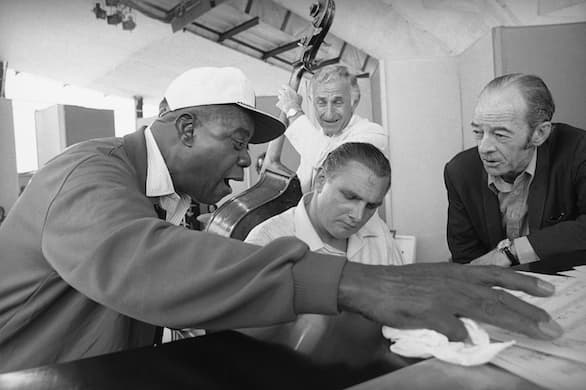
AP/J. Walter Green
Dave McKenna is at center as Louis Armstrong sings during an informal rehearsal at the Newport Jazz Festival, July 10, 1970. Also pictured: Jack Lesberg on bass and trumpeter Bobby Hackett. AP/J. Walter Green

‘Dave McKenna: The Key Man’ 
Directed by Greg Mallozzi, streaming via Qwest TV

In November 1999, pianist Dave McKenna, the subject of a new documentary, gave a solo concert at the Sarasota Opera House in Florida. In 2002, the year that McKenna retired, the recording was issued as “An Intimate Evening with Dave McKenna.” It opens with a performance that never fails to make my hair — at least what little I have left of it — stand on end.  

McKenna lunges into the 1918 New Orleans number “Fidgety Feet,” a tune played even to this day by every dixieland band known to mankind but rarely by solo pianists. Perhaps because it’s foremost a band number, McKenna plays in an especially full-fingered fashion, making his keyboard sound like an entire ensemble. As he builds to his pinnacle of excitement, he creates the impression of at least two distinct piano players at two separate instruments in competition with each other.

In most piano jazz, the right hand plays melody while the left takes care of the harmony. Yet in “Fidgety Feet” — and hundreds of other tracks in McKenna’s discography — the left hand and the right hand are so completely independent of each other that I can never shake the feeling that there are somehow more than two hands playing. I kept looking at the album information to make sure that McKenna wasn’t joined by another pianist or, possibly, had overdubbed another track at some point.

Dave McKenna (1930-2008) spent most of his career playing with swing and traditional jazzmen from New England, but his own playing transcended boundaries and categories. His primary vehicle was the unaccompanied solo keyboard, which is normally the province of stride players, yet little of what McKenna played could be classified as such.  “Fidgety Feet,” for instance, has little in the way of stride mannerisms; the energy is more suggestive of Jelly Roll Morton, Earl Father Hines, or Art Tatum than the New York stride players, particularly as he builds toward an emotional climax.  

He somehow creates the impression of a “tutti,” that moment after the individual solos where all the players come together. It’s nothing less than magical that one single virtuoso player can do this — create the impression of multiple players playing separate but contrapuntal parts, and then somehow BRINGING IT ALL BACK together.

I’m thankful for “The Key Man,” not only for telling McKenna’s story but for giving us all the excuse to revisit his music. It’s a relatively short film, only 52 minutes, and gets to the point, sketching the outlines of McKenna’s career. We start with his child prodigy years, and then move to his apprenticeship with groups that split the difference between swing and bop, like Charlie Ventura and Woody Herman. Throughout the 1950s, McKenna was a busy freelance sideman. By the 1960s and ’70s, McKenna gradually became a solo star and a jazz circuit headliner even as the mass market for the music was slowly closing in on itself.

McKenna’s close friends, including producer Hank O’Neill (who was responsible for the pianist’s classic 1973 solo album) and deejay Ron Della Chiesa, along with his sister and his sons, testify to the man’s character. Perhaps it’s because he never had to work at playing — it seems to have come to him automatically — that, subsequently, he never placed any value on his music or even himself. There’s nary a statement McKenna doesn’t utter in this presentation that isn’t self-deprecating in the extreme. 

For a talent of his magnitude, there’s relatively little visual footage out there of McKenna in action. Conversely, he was one of the most recorded jazz pianists of his time; I’m hardly a completist, yet I have more than 60 McKenna albums in my private stash — not including his many sessions as a sideman.

My recommendation is to spend an hour with the documentary and then indulge in as many McKenna albums as your time and budget will allow.  The 1973 “Solo Piano” album with his bebop flight of fancy, Charlie Parker’s “Scrapple from the Apple,” is outstanding, though the 1999 live concert captures an older and more emotionally profound player.

Here, he follows “Fidgety Feet” with a deeply moving reading of “I Thought About You,” playing the melody thoughtfully as a slow ballad in 4/4, then shifting gears into the same Jimmy Van Heusen tune as an uptempo waltz. Then, without a pause, he then detours through “Thinking of You” and “The Very Thought of You,” before heading back to the original “Thought About You,” now in a strident two-beat. The uninterrupted 12-minute track illustrates how McKenna was one of the few virtuoso instrumentalists to think about a song’s words, its title, and its programmatic content.   

It became McKenna’s custom to construct extended multi-song collages in this fashion; this one is listed on the album notes as “Thought Medley” and it’s followed by a “Change Medley,” which starts with “There’ll Be Some Changes Made” and “You’ve Changed” but dwells most furtively on “Change Partners,” played in several different rhythms, including a bossa nova interpretation inspired by that of Frank Sinatra and Antonio Carlos Jobim. McKenna would eventually build entire albums around such concepts, such as his brilliant 1990 “Shadows ’N Dreams” and the 1992 “Handful of Stars.” 

McKenna’s story, as presented in “The Key Man,” doesn’t end on an upbeat note; he stopped playing abruptly in 2002, when he felt he could no longer perform to his own standard, and spent his last few years none too happy as a recluse. 

McKenna fans — and there are doubtlessly more now than there were at the time of his demise 15 years ago — have described his style as “three-handed swing.” I can see, and hear, the point of that, yet what Dave McKenna was doing with his hands was never as important as what he was doing to our hearts.


The New York Sun

© 2025 The New York Sun Company, LLC. All rights reserved.

Use of this site constitutes acceptance of our Terms of Use and Privacy Policy. The material on this site is protected by copyright law and may not be reproduced, distributed, transmitted, cached or otherwise used.

The New York Sun

Sign in or  create a free account

or
By continuing you agree to our Privacy Policy and Terms of Use