


An Exquisite Off-Broadway Reinvention Retains Stoppard’s Spirit
By ELYSA GARDNER
|John Erskine’s poem is one you run your eye over, one of a hundred anthology pieces. Then something about it makes you stop and read it again.
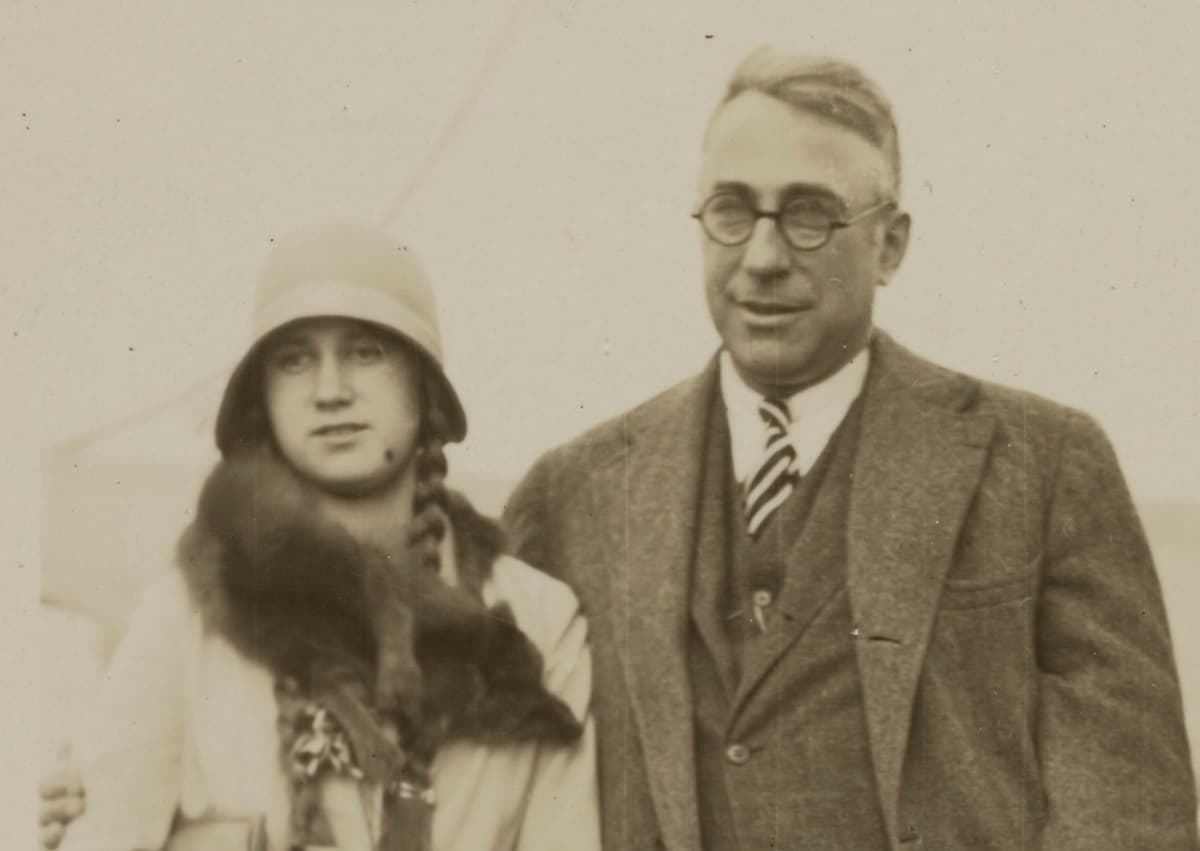
Today we remember John Erskine (1879–1951) chiefly as the author of a 1915 essay, “The Moral Obligation to be Intelligent,” first read before the Phi Beta Kappa society at Amherst College, where Erskine then taught. As a corollary, we remember Erskine next as one of the cohort of educators, including also Mortimer Adler and Mark van Doren, responsible for what we know today as Honors College and Great Books programs in higher education. We might not so quickly recall that Erskine was also a pianist and composer. And like Mark van Doren, whose “Wind in the Grass” and “River Snow” have appeared in this space — indeed, like just about anyone of his generation, but with a sensitive ear and a gift for compressed poetic drama — he could write verse.
Today’s Poem of the Day, “Apparation,” appeared in 1920, first in Harper’s Magazine, then in an anthology of “Magazine Verse” for that year, edited by William Stanley Braithwaite (1878–1962). There, Erskine appears in a catalog of literary names both famous and forgotten: Robert Frost, Conrad Aiken, Edwin Arlington Robinson, and Edna St. Vincent Millay, but also Aloysius Coll, Gordon Malherbe Hillman, Howard Mumford Jones, and Myrtle Eberstein. In short, 1920 as a year for magazine verse was, on many levels, a mixed bag.
But like Scudder Middleton (1888–1959), whose “Song in the Key of Autumn” featured as Poem of the Day last October 18, Erskine emerges from this crowd as something of a surprise. His “Apparition” is a poem you run your eye over, one of a hundred anthology pieces. Then something about it makes you stop and read it again. Its easy iambic-pentameter quatrains, despite their occasionally mannered moments — “I am come home,” said nobody in the twentieth century — build a Twilight-Zone-ish scene of return and recognition. Yet what the speaker recognizes, poignantly, at the poem’s end, is that he and the one he loves are strangers, no more than phantoms to each other. Everything familiar is a cold and alien land.
By ELYSA GARDNER
|
By MARIO NAVES
|
By THE NEW YORK SUN
|
By LAWRENCE KUDLOW
|
By BRADLEY CORTRIGHT
|
By THE NEW YORK SUN
|
By JOSEPH CURL
|
By CARL ROLLYSON
|Today we remember John Erskine (1879–1951) chiefly as the author of a 1915 essay, “The Moral Obligation to be Intelligent,” first read before the Phi Beta Kappa society at Amherst College, where Erskine then taught. As a corollary, we remember Erskine next as one of the cohort of educators, including also Mortimer Adler and Mark van Doren, responsible for what we know today as Honors College and Great Books programs in higher education. We might not so quickly recall that Erskine was also a pianist and composer. And like Mark van Doren, whose “Wind in the Grass” and “River Snow” have appeared in this space — indeed, like just about anyone of his generation, but with a sensitive ear and a gift for compressed poetic drama — he could write verse.
Today’s Poem of the Day, “Apparation,” appeared in 1920, first in Harper’s Magazine, then in an anthology of “Magazine Verse” for that year, edited by William Stanley Braithwaite (1878–1962). There, Erskine appears in a catalog of literary names both famous and forgotten: Robert Frost, Conrad Aiken, Edwin Arlington Robinson, and Edna St. Vincent Millay, but also Aloysius Coll, Gordon Malherbe Hillman, Howard Mumford Jones, and Myrtle Eberstein. In short, 1920 as a year for magazine verse was, on many levels, a mixed bag.
But like Scudder Middleton (1888–1959), whose “Song in the Key of Autumn” featured as Poem of the Day last October 18, Erskine emerges from this crowd as something of a surprise. His “Apparition” is a poem you run your eye over, one of a hundred anthology pieces. Then something about it makes you stop and read it again. Its easy iambic-pentameter quatrains, despite their occasionally mannered moments — “I am come home,” said nobody in the twentieth century — build a Twilight-Zone-ish scene of return and recognition. Yet what the speaker recognizes, poignantly, at the poem’s end, is that he and the one he loves are strangers, no more than phantoms to each other. Everything familiar is a cold and alien land.
Already have a subscription? Sign in to continue reading
Cancel anytime
By continuing you agree to our Privacy Policy and Terms of Service.
Cancel anytime