

‘Resident Evil’ Heralds the Return of Fun Back Into Horror Movies
By GAGE KLIPPER
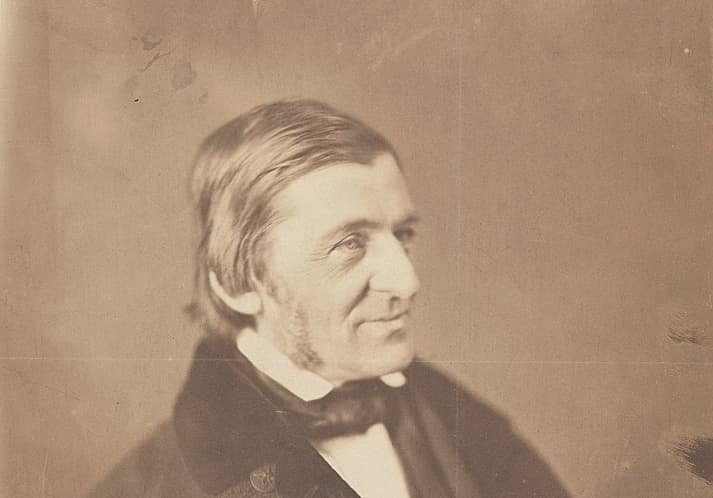
|Emerson saw, on the one hand, the permanence of nature’s laws, and on the other hand, nature’s fluid relationship with human consciousness as it both shapes and is shaped by our perceptions.

Published:
Updated:
In his once-famous 1836 essay, “Nature,” the American Transcendentalist Ralph Waldo Emerson (1803–1882) set out to “interrogate the grand apparition, that shines so peacefully around us.” “Water,” today’s Poem of the Day, interrogates one element in that “grand apparition,” according to Emerson’s scheme for understanding the natural world: on the one hand, the permanence of nature’s laws, and on the other hand, nature’s fluid relationship with human consciousness as it both shapes and is shaped by our perceptions.
What better image than water for that complicated “conspiracy” between nature and spirit? In this little trimeter poem, whose lines quickly resolve into rhymed couplets, the water possesses a measure of human-like understanding, lending itself as a commodity for human use. At the same time, as the ending reminds us, beautiful and “elegant” though the water appears to us, its ways are not our ways.
By GAGE KLIPPER
|
By ELYSA GARDNER
|
By BENNY AVNI
|
By THE NEW YORK SUN
|
By LAWRENCE KUDLOW
|
By LUKE FUNK
|
By MATTHEW RICE
|
By ALEX ZDAN
|In his once-famous 1836 essay, “Nature,” the American Transcendentalist Ralph Waldo Emerson (1803–1882) set out to “interrogate the grand apparition, that shines so peacefully around us.” “Water,” today’s Poem of the Day, interrogates one element in that “grand apparition,” according to Emerson’s scheme for understanding the natural world: on the one hand, the permanence of nature’s laws, and on the other hand, nature’s fluid relationship with human consciousness as it both shapes and is shaped by our perceptions.
What better image than water for that complicated “conspiracy” between nature and spirit? In this little trimeter poem, whose lines quickly resolve into rhymed couplets, the water possesses a measure of human-like understanding, lending itself as a commodity for human use. At the same time, as the ending reminds us, beautiful and “elegant” though the water appears to us, its ways are not our ways.
Already have a subscription? Sign in to continue reading
Cancel anytime
By continuing you agree to our Privacy Policy and Terms of Service.
Cancel anytime