


Israel’s Next Liberation
By THE NEW YORK SUN
|Why are poets so obsessed with death? The answer is that poets are obsessed with reality. And what’s more real than death, inescapable and universal?
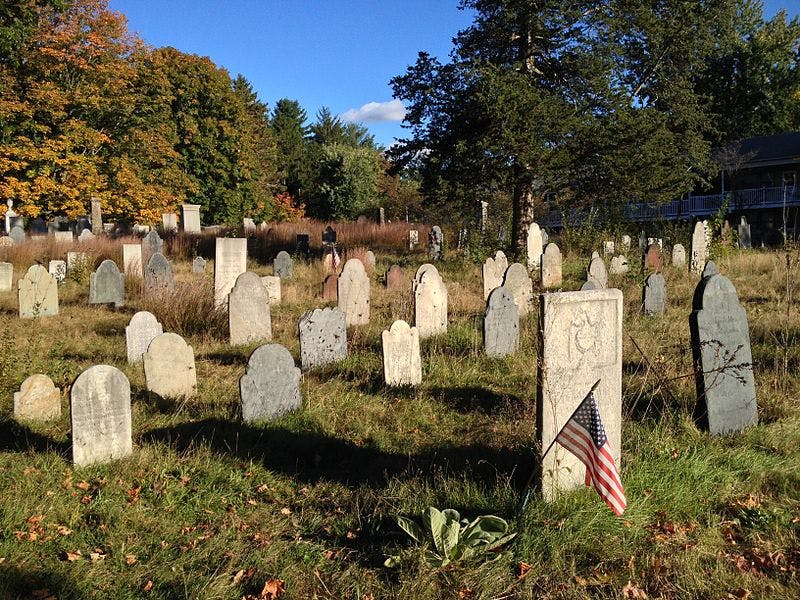
To mark the December 10 birthday of Emily Dickinson (1830–1886), today we offer our readers an emblematic Dickinson poem: a poem about death. Reading Dickinson, we can readily feel that for every poem that begins, “Hope is the thing with feathers,” there are five more poems that begin with such lines as, “I heard a fly buzz when I died.” Or, “Because I could not stop for Death, / He kindly stopped for me.” And feeling this way, we ask ourselves, Why are poets so obsessed with death?
The answer, of course, is that poets are obsessed with reality. And what’s more real than death, inescapable and universal? Sun readers will recall, for example, Tennyson’s “Ulysses,” which takes death’s inevitability as its subject. Tennyson, the laureate, speaking for a country and a culture, asks, “How will we die?” It’s an uncomfortable question. Nobody wants to think about dying. The best most of us can do is to consider death as a thing that happens to other people, though it leaves its painful mark on us as well.
Strikingly, what Dickinson so often considers is not how, as a culture, to think about death. Instead, she asks how she herself will die. In today’s poem, for example, with her characteristic slant-rhymed common- or hymn-meter quatrains, she imagines death as a thing which happens not to somebody else, not to the whole mass of humanity, but to her. It rehearses, imaginatively, the personal experience of being dead. What will that be like?
Her newly deceased speaker at first apprehends her own death as a series of sensory impressions, which she is conscious enough, still, to understand and narrate as events in time. She describes, in sequence, the feeling of the “Funeral, in my Brain,” with the tramping feet of mourners, the monotone drumroll of the church service, the creaking of boots as her coffin is lifted and carried. Yet then, like a person being hanged, she feels the “Plank in Reason” break beneath her. As the poem ends, on an inconclusive em-dash, its thoughts cut short, its speaker drops utterly out of “knowing” into the unimaginable, timeless, silent mystery beyond.
By THE NEW YORK SUN
|
By LUKE FUNK
|
By ALEX ZDAN
|
By MATTHEW RICE
|
By BRADLEY CORTRIGHT
|
By THE NEW YORK SUN
|
By GEORGE WILLIS
|
By JOSEPH CURL
|To mark the December 10 birthday of Emily Dickinson (1830–1886), today we offer our readers an emblematic Dickinson poem: a poem about death. Reading Dickinson, we can readily feel that for every poem that begins, “Hope is the thing with feathers,” there are five more poems that begin with such lines as, “I heard a fly buzz when I died.” Or, “Because I could not stop for Death, / He kindly stopped for me.” And feeling this way, we ask ourselves, Why are poets so obsessed with death?
The answer, of course, is that poets are obsessed with reality. And what’s more real than death, inescapable and universal? Sun readers will recall, for example, Tennyson’s “Ulysses,” which takes death’s inevitability as its subject. Tennyson, the laureate, speaking for a country and a culture, asks, “How will we die?” It’s an uncomfortable question. Nobody wants to think about dying. The best most of us can do is to consider death as a thing that happens to other people, though it leaves its painful mark on us as well.
Strikingly, what Dickinson so often considers is not how, as a culture, to think about death. Instead, she asks how she herself will die. In today’s poem, for example, with her characteristic slant-rhymed common- or hymn-meter quatrains, she imagines death as a thing which happens not to somebody else, not to the whole mass of humanity, but to her. It rehearses, imaginatively, the personal experience of being dead. What will that be like?
Her newly deceased speaker at first apprehends her own death as a series of sensory impressions, which she is conscious enough, still, to understand and narrate as events in time. She describes, in sequence, the feeling of the “Funeral, in my Brain,” with the tramping feet of mourners, the monotone drumroll of the church service, the creaking of boots as her coffin is lifted and carried. Yet then, like a person being hanged, she feels the “Plank in Reason” break beneath her. As the poem ends, on an inconclusive em-dash, its thoughts cut short, its speaker drops utterly out of “knowing” into the unimaginable, timeless, silent mystery beyond.
Cancel anytime
By continuing you agree to our Privacy Policy and Terms of Service.
Cancel anytime