


Sydney Sweeney’s Nude Betting Ad Sparks Fresh Controversy Over ‘Sexualizing’ Women’s Sport
By JOSEPH CURL
|Thomas Hardy sketches the sort of scene, with its brightness and its undercutting darkness, that we recognize in later poets like Robert Frost: an observer in nature whose mood is at one with the landscape, until some epiphanic encounter.
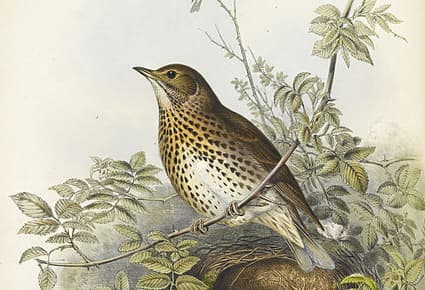
Our poetry week, which began with Sara Teasdale’s “A Winter Blue Jay,” closes with another bird poem, another epiphany in which joy is witnessed, if (this time) not also experienced. Over the course of a long life, Thomas Hardy (1840–1928) was first a novelist, then a poet so prolific that, as has been pointed out here before, the reader is constantly discovering a hitherto-unknown Hardy poem. In this way, as on every other level, his body of work is a continual epiphany. Yet “The Darkling Thrush” is, for most readers, the Hardy poem.
“The Darkling Thrush” looks back on a Romantic world in which nature resonates with a life larger than itself. At the same time, it sets its face for an era in which man exists in isolation in a dark cosmos, and in imprisonment in himself. In common-meter octets with a simple abab rhyme scheme, the poem sketches the sort of scene, with its brightness and its undercutting darkness, that we recognize in later poets like Robert Frost: an observer in nature whose mood is at one with the landscape, until some epiphanic encounter.
Think, for example, of Frost’s brief “Dust of Snow” — but imagine a speaker whose regretted day can’t be saved, in any part, by the action of a bird. Hardy’s speaker witnesses the ancient thrush as it sings what might plausibly be its last song, in the shadow of death. He recognizes the “joy illimited” in that song, and even the “Hope” that illuminates it. In the words of the Greek Kontakion for the Dead, “even at the grave,” this creature at home in the natural world makes its alleluia. But the poem’s speaker sees, hears, and recognizes this song as one in exile, locked out of the joy and hope beyond the surfaces of the world he apprehends, but also insensible of them, “unaware.”
By JOSEPH CURL
|
By LUKE FUNK
|
By JENNIFER DOHERTY
|
By STEPHEN MacLEAN
|
By BRADLEY CORTRIGHT
|
By JOSEPH CURL
|
By A.R. HOFFMAN
|
By DAVID MASTIO
|Our poetry week, which began with Sara Teasdale’s “A Winter Blue Jay,” closes with another bird poem, another epiphany in which joy is witnessed, if (this time) not also experienced. Over the course of a long life, Thomas Hardy (1840–1928) was first a novelist, then a poet so prolific that, as has been pointed out here before, the reader is constantly discovering a hitherto-unknown Hardy poem. In this way, as on every other level, his body of work is a continual epiphany. Yet “The Darkling Thrush” is, for most readers, the Hardy poem.
“The Darkling Thrush” looks back on a Romantic world in which nature resonates with a life larger than itself. At the same time, it sets its face for an era in which man exists in isolation in a dark cosmos, and in imprisonment in himself. In common-meter octets with a simple abab rhyme scheme, the poem sketches the sort of scene, with its brightness and its undercutting darkness, that we recognize in later poets like Robert Frost: an observer in nature whose mood is at one with the landscape, until some epiphanic encounter.
Think, for example, of Frost’s brief “Dust of Snow” — but imagine a speaker whose regretted day can’t be saved, in any part, by the action of a bird. Hardy’s speaker witnesses the ancient thrush as it sings what might plausibly be its last song, in the shadow of death. He recognizes the “joy illimited” in that song, and even the “Hope” that illuminates it. In the words of the Greek Kontakion for the Dead, “even at the grave,” this creature at home in the natural world makes its alleluia. But the poem’s speaker sees, hears, and recognizes this song as one in exile, locked out of the joy and hope beyond the surfaces of the world he apprehends, but also insensible of them, “unaware.”
Cancel anytime
By continuing you agree to our Privacy Policy and Terms of Service.
Cancel anytime