

New York Film Festival Review: ‘Behemoth!’ Has Nine Composers and No Heart
By SEBASTIAN DOGGART
|You can feel the buzz in the meter of what James Whitcomb Riley intended as an archetypal poem of American experience.
James Whitcomb Riley (1849–1916) invented Midwestern literature. Oh, such fellow Hoosiers as the local colorist Edward Eggleston were probably more successful at conveying the dialect. Booth Tarkington and Theodore Dreiser proved better at art. George Barr McCutcheon, Gene Stratton Porter, Lew Wallace: There was a lot going in Indiana from 1880 to around 1920. But through much of the era there was the figure of James Whitcomb Riley, running from poetry reading to poetry reading as he sold the idea of an authentic American verse.
Before the decline of poetry reading after the 1950s (and the rise, within the diminished poetic realm, of a sneer at the old popular verse) such work as Riley’s “Little Orphant Annie” (1885) and “The Raggedy Man” (1888) were well known and widely recited. That’s not to say the poems were taken entirely seriously. No one thought Riley ranked beside Longfellow and Tennyson. But his poems were read wryly and with genuine enjoyment. Riley was fun — fun to read and fun to recite.
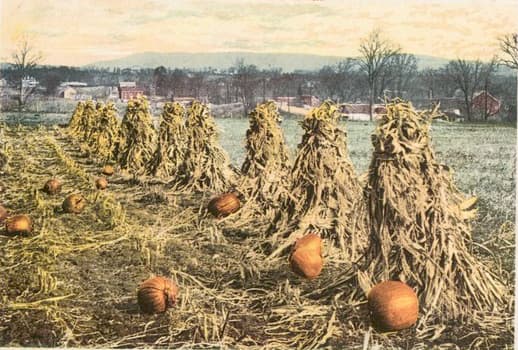
Take, for example, today’s poem of the day, Riley’s 1883 “Boone County” poem called “When the Frost Is on the Punkin.” The seven-foot lines in rhymed couplets rattle on about farm life once “the heat of summer’s over and the coolin’ fall is here.” You can feel the buzz in the meter of what Riley intended as an archetypal poem of American experience, and the humor in the dialectical spellings, and the sentimentality that was simultaneously the triumph and the disaster of the local colorism that exploded in America — especially in Midwestern literature. Mostly though, the poem is fun. And what more does a reader want?
By SEBASTIAN DOGGART
|
By JOSEPH CURL
|
By GEORGE WILLIS
|
By HOLLIE McKAY
|
By DAVID JONES
|
By JOSEPH CURL
|
By THE NEW YORK SUN
|
By LAURA THOMPSON
|James Whitcomb Riley (1849–1916) invented Midwestern literature. Oh, such fellow Hoosiers as the local colorist Edward Eggleston were probably more successful at conveying the dialect. Booth Tarkington and Theodore Dreiser proved better at art. George Barr McCutcheon, Gene Stratton Porter, Lew Wallace: There was a lot going in Indiana from 1880 to around 1920. But through much of the era there was the figure of James Whitcomb Riley, running from poetry reading to poetry reading as he sold the idea of an authentic American verse.
Before the decline of poetry reading after the 1950s (and the rise, within the diminished poetic realm, of a sneer at the old popular verse) such work as Riley’s “Little Orphant Annie” (1885) and “The Raggedy Man” (1888) were well known and widely recited. That’s not to say the poems were taken entirely seriously. No one thought Riley ranked beside Longfellow and Tennyson. But his poems were read wryly and with genuine enjoyment. Riley was fun — fun to read and fun to recite.
Take, for example, today’s poem of the day, Riley’s 1883 “Boone County” poem called “When the Frost Is on the Punkin.” The seven-foot lines in rhymed couplets rattle on about farm life once “the heat of summer’s over and the coolin’ fall is here.” You can feel the buzz in the meter of what Riley intended as an archetypal poem of American experience, and the humor in the dialectical spellings, and the sentimentality that was simultaneously the triumph and the disaster of the local colorism that exploded in America — especially in Midwestern literature. Mostly though, the poem is fun. And what more does a reader want?
Cancel anytime
By continuing you agree to our Privacy Policy and Terms of Service.
Cancel anytime