


RFK Jr. Launches New Federal Autism Research Program
By LUKE FUNK
|A century after Wallace Stevens published his first book of poetry, it’s worth trying to understand what he was seeking and what he achieved in his work.
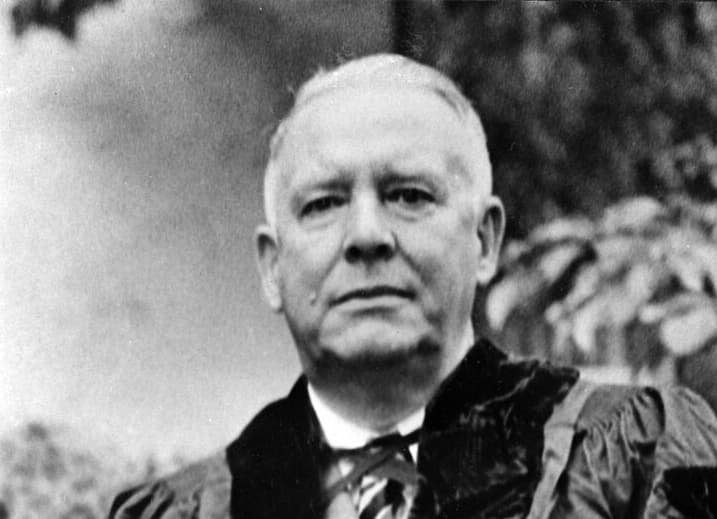
In 1923 Wallace Stevens (1879–1955) published “Harmonium,” his first book of poetry. And now, a hundred years later, it’s worth returning to that volume, trying to understand what the poet was seeking and what he achieved in his work. The Sun has already looked at “The Emperor of Ice-Cream,” joining “The Snow Man” as the most widely anthologized poems from the book.
But today’s Poem of the Day, “Tea at the Palaz of Hoon,” may be even more central to Stevens’s poetic development — even more central to his life, for that matter, and the creation of the persona he presents in his poems.
The poem mentions a curious “you” in the second line as it describes the self as an imperial presence, descending “in purple,” with unknown “ointment sprinkled on my beard,” unexpected “hymns that buzzed beside my ears,” and an undetermined sea that swept the self into a vision of itself as an ancient emperor. The philosophical turn is the imagined discovery that the self creates itself. “I was the world in which I walked, . . . / And there I found myself more truly and more strange.”
Present through all this is Stevens’s surface gloss of hedonistic sensualism. But beneath that, there lurks a solipsistic philosophy — and beneath that there lurks a moralistic sense of his Puritan American forebears. Wallace Stevens is somehow simultaneously among our most sensual poets, our most philosophical poets, and our sternest poets.
By LUKE FUNK
|
By BRADLEY CORTRIGHT
|
By ALEX ZDAN
|
By VERONIQUE de RUGY
|
By JENNIFER DOHERTY
|
By A.R. HOFFMAN
|
By MATTHEW RICE
|
By CARLOS SOUSA
|In 1923 Wallace Stevens (1879–1955) published “Harmonium,” his first book of poetry. And now, a hundred years later, it’s worth returning to that volume, trying to understand what the poet was seeking and what he achieved in his work. The Sun has already looked at “The Emperor of Ice-Cream,” joining “The Snow Man” as the most widely anthologized poems from the book.
But today’s Poem of the Day, “Tea at the Palaz of Hoon,” may be even more central to Stevens’s poetic development — even more central to his life, for that matter, and the creation of the persona he presents in his poems.
The poem mentions a curious “you” in the second line as it describes the self as an imperial presence, descending “in purple,” with unknown “ointment sprinkled on my beard,” unexpected “hymns that buzzed beside my ears,” and an undetermined sea that swept the self into a vision of itself as an ancient emperor. The philosophical turn is the imagined discovery that the self creates itself. “I was the world in which I walked, . . . / And there I found myself more truly and more strange.”
Present through all this is Stevens’s surface gloss of hedonistic sensualism. But beneath that, there lurks a solipsistic philosophy — and beneath that there lurks a moralistic sense of his Puritan American forebears. Wallace Stevens is somehow simultaneously among our most sensual poets, our most philosophical poets, and our sternest poets.
Cancel anytime
By continuing you agree to our Privacy Policy and Terms of Service.
Cancel anytime